Non-Sleep Deep Rest (NSDR): What It Is and How to Do It
The short answer
Non-sleep deep rest (NSDR) is a short practice in which you lie or sit still, close your eyes, and follow slow breathing and body-awareness cues while staying awake. Sessions typically run ten to twenty minutes, usually guided by a recording. It overlaps closely with yoga nidra and is not a substitute for actual sleep.
Non-sleep deep rest, usually shortened to NSDR, is a short practice where you lie or sit still, close your eyes, and follow a slow sequence of breathing and body-awareness cues while staying awake. People use it during a midday slump, after a short night of sleep, or simply to come down from a stretch of focused work or stress. It typically takes ten to twenty minutes and requires no equipment beyond a quiet space and, usually, a recorded voice guiding you through it.
The term was popularized by Stanford neuroscientist Andrew Huberman as a plain-language way to describe a family of rest techniques, including practices adapted from yoga nidra, without the spiritual framing some readers find offputting or unfamiliar. Below is what the practice actually involves, what it can realistically do, and where its limits are.
What happens during an NSDR session
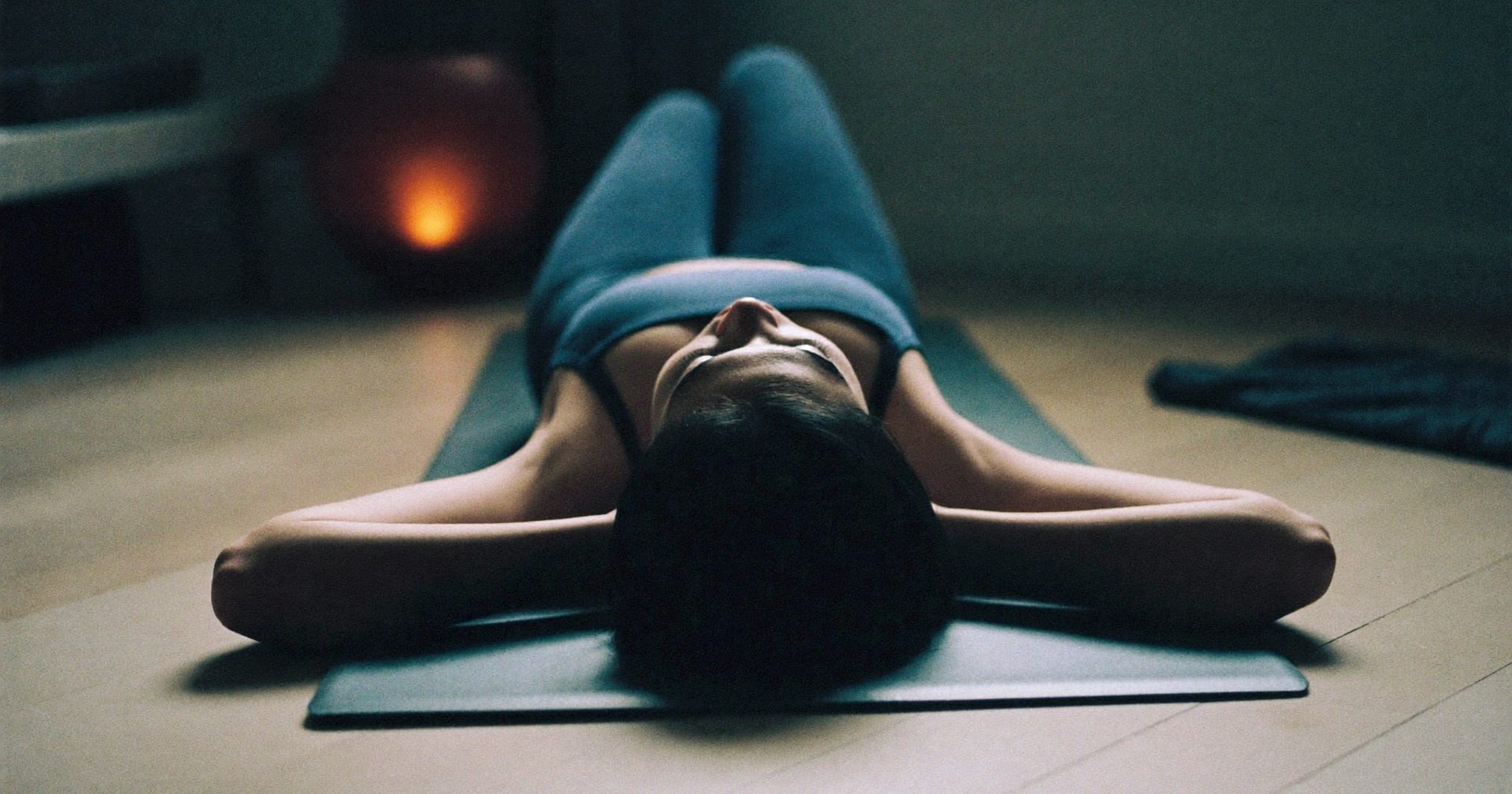
A typical session follows a simple arc. You get into a comfortable position, usually lying on your back with your eyes closed. A guide (an app, recording, or your own mental script) walks you through slowing and lengthening your breath, then directs your attention through different parts of your body in turn – feet, legs, torso, arms, face – inviting each area to soften and grow heavy. Toward the end, there’s usually a stretch of quiet stillness before you’re guided to gently reorient and open your eyes.
Nothing about this requires belief in anything, and there is no goal beyond letting your attention settle. If your mind wanders, as it will, you simply return to the next cue when you notice. Unlike a meditation practice built around sustained focus, NSDR scripts do most of the directing for you, which is part of why people who find silent meditation difficult often find this easier to stick with.
What’s happening in the body, in plain terms
The general physiology behind rest practices like this one is well established, even if the research on NSDR specifically is newer. Your nervous system runs on a rough balance between two modes: a sympathetic, activating mode that shows up as a faster heart rate, shallow breathing, and tense muscles, and a parasympathetic, settling mode associated with slower breathing, a lower heart rate, and looser muscles. Slow, extended exhales and sustained stillness are generally associated with a shift toward that second, calmer mode.
That’s a description of ordinary nervous-system physiology, not a specific claim about what any one NSDR session will do for any one person. Bodies vary, stress levels vary day to day, and a single session is not a guaranteed reset button. What the practice offers is a low-effort way to nudge things in a calmer direction, not a mechanism with a predictable, measurable outcome every time.
How it’s different from meditation, napping, and yoga nidra
These practices overlap, and the boundaries are blurry in casual conversation, but a few distinctions are useful.
| Practice | What it involves | Goal |
|---|---|---|
| NSDR | Guided breath and body-scan script, eyes closed, staying awake | Settle the nervous system without sleeping |
| Napping | Actual sleep, often 10-30 minutes | Reduce sleep pressure, restore alertness |
| Seated meditation | Sustained attention on breath, sensation, or a chosen object, often upright | Train attention and awareness |
| Yoga nidra | A longer-standing guided practice with a similar structure to NSDR, rooted in a specific yogic tradition | Deep relaxation while remaining conscious |
NSDR is best understood as a secular framing of practices like yoga nidra, and the two overlap heavily in structure. The main practical difference is language and packaging rather than technique. If you’ve done a body-scan meditation or a guided relaxation class before, you’ve likely already done something very close to NSDR without the label.
Common ways people practice it
There’s no single official version of NSDR, which is part of why the practice looks slightly different depending on where you learn it. A few common formats:
- Short reset sessions of five to ten minutes, often used mid-workday between tasks or meetings.
- Full-length sessions of twenty to thirty minutes, usually done lying down and closer to a nap in feel, though the goal is to stay awake through it.
- Free guided recordings from meditation and wellness apps, many of which are labeled NSDR, body scan, or guided relaxation interchangeably.
- Self-guided versions, where an experienced practitioner runs through a mental script of breath and body cues without an audio guide.
- Yoga nidra classes, in person or recorded, which use a similar structure with somewhat more ritual and framing around it.
None of these formats is inherently better than the others. The right one is whichever you’ll actually use consistently.
What people commonly report
People who practice NSDR regularly often describe feeling calmer, less mentally scattered, and less physically tense afterward, especially when the session follows a stretch of stress or a poor night’s sleep. Some notice it easier to fall asleep later that night; others use it simply to reset attention in the middle of a demanding day. A common description is that a session doesn’t feel dramatic in the moment but leaves a noticeable difference in how heavy or wound-up the body feels once it’s over.
Researchers have studied guided rest practices with this structure, including yoga nidra specifically, looking at outcomes like self-reported stress, anxiety, and sleep quality. One of the larger examples is an online study in which people used an 11-minute yoga nidra recording for 30 days and reported lower stress and better sleep quality than a waitlist group, although the effects were very small to small (Moszeik, von Oertzen and Renner, Current Psychology). The general pattern in that research is encouraging but preliminary – many of the studies are small, use different methods to measure outcomes, and don’t yet follow people for long periods of time. That means NSDR is reasonably described as a promising, low-risk practice worth trying, not as a proven treatment for any condition.
Why it isn’t a substitute for sleep
NSDR does not replace the restorative processes that happen during actual sleep, including the deeper stages where the brain and body do work that a wakeful rest practice simply doesn’t reach. It can be a useful tool for taking the edge off fatigue or stress in the moment, but it shouldn’t be treated as a way to catch up on lost sleep or to justify a consistently short night. If you’re chronically under-slept, the more effective fix is addressing your sleep schedule directly, not adding a rest practice on top of it. Think of NSDR as something that sits alongside good sleep habits, not something that stands in for them.
How to try it
- Pick a quiet stretch of ten to twenty minutes where you won’t be interrupted, and put your phone on do-not-disturb.
- Lie down if you can, or sit reclined if lying down tends to put you to sleep.
- Use a guided recording at first rather than trying to freestyle it – following someone else’s pacing makes it easier to stay engaged without effort.
- Let your exhale run a little longer than your inhale as you settle in; this is a common cue in most scripts.
- Don’t judge the session by whether your mind stayed perfectly quiet. Noticing you drifted and coming back is the practice, not a failure of it.
- Try it at a consistent time, such as after lunch or before an evening wind-down, so it becomes a cue your body recognizes.
A couple of common snags are worth naming. If you fall asleep every time, that isn’t a failure, but it does mean you’re napping rather than practicing NSDR specifically – try sitting reclined instead of lying flat, or practice earlier in the day when you’re less sleep-pressured. If you feel restless or can’t settle at all, a shorter session, or a few slow physical stretches beforehand, often helps more than pushing through a full twenty minutes.
When to try something else instead
NSDR is a low-risk practice for most healthy adults, but it isn’t a fix for everything that can go wrong with sleep or stress. If you regularly struggle to fall or stay asleep, wake up gasping or feeling unrested despite enough time in bed, or notice that anxiety or low mood is affecting your daily life, those are signs worth raising with a doctor rather than managing through a rest practice alone. A short guided session can be a helpful part of a broader routine, but it isn’t a diagnosis or a treatment, and it shouldn’t delay getting checked out if something feels off.
Getting started without overthinking it
The appeal of NSDR is partly its simplicity: there’s no equipment to buy, no class to attend, and no tradition you need to learn first. The most reliable way to find out whether it’s useful for you is to try a single guided session this week, notice how you feel afterward compared to before, and repeat it a few times before deciding whether it earns a regular spot in your day. If it clicks, it costs nothing to keep doing; if it doesn’t, you’ve lost twenty quiet minutes and learned something about what actually helps you unwind.
Frequently Asked Questions
How long should an NSDR session be?
Most guided sessions run ten to twenty minutes, though some go up to thirty. There's no strict rule – shorter sessions are easier to fit into a workday, while longer ones give you more time to settle before the session ends.
Is NSDR the same thing as yoga nidra?
They overlap closely in structure – both use guided breath and body-awareness cues while you stay awake and still. NSDR is generally used as a secular, plain-language framing of the same basic technique, so the practical difference is mostly in presentation rather than what you actually do.
Can NSDR help me fall asleep faster at night?
Some people find that a calming practice earlier in the evening makes it easier to wind down later, but NSDR is not itself a sleep aid and won't reliably fix ongoing insomnia. If falling or staying asleep is a persistent problem, it's worth discussing with a clinician.
Do I need an app or recording to do NSDR?
It's easier to start with a guided recording, since following someone else's pacing takes the effort out of remembering what to do next. Once you're familiar with the structure, some people move to a shorter mental script they run through on their own.
Is NSDR safe for everyone?
It's low-risk for most healthy adults since it involves only rest, breathing, and attention. If you have a diagnosed sleep, anxiety, or mood condition, it's reasonable to use NSDR alongside your care, but check with your clinician before relying on it in place of any treatment they've recommended.
New readings and guides by email
The title, a short excerpt and a link for each new reading or guide on this site. At most two emails a month.