The 7th House in Astrology: Partners, Contracts and Open Rivals
The short answer
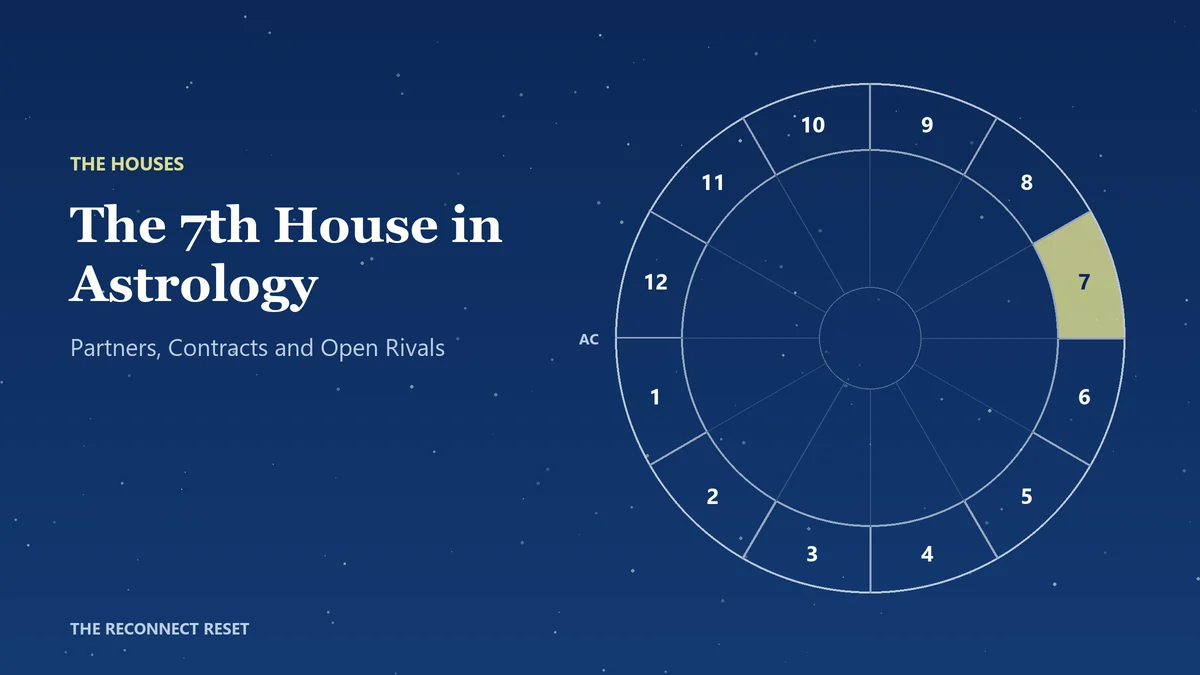
In 7th house astrology, the seventh house describes your one-to-one relationships: marriage, committed partners, business partners, contracts and open rivals. Its cusp is the Descendant, opposite your rising sign, so it is read as what you seek in, and often project onto, the people who stand across from you.
Every chart has a horizon, and the 7th house begins where the Sun sets. This reference explains what the house covers, how the Descendant and cusp sign work, what the ruler's placement and other house lords in the 7th suggest, the planets that can sit there, and what an empty 7th house does and does not mean.
What 7th House Astrology Covers
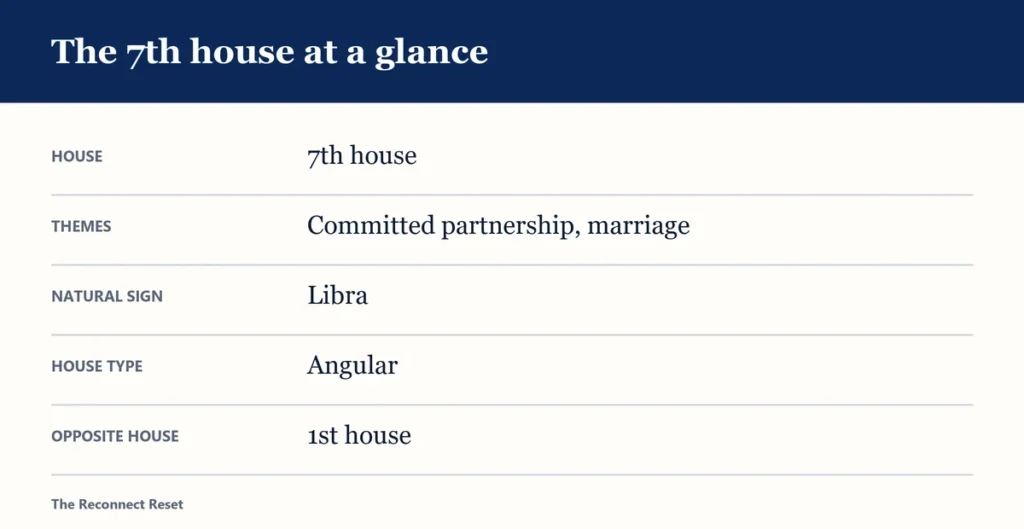
The seventh house rules relationships between equals: marriage and long-term partnership, business partnerships, contracts and formal agreements, and anyone you deal with one to one, from consultants to opponents. Traditional astrology also gave it open enemies, meaning known rivals and adversaries in disputes, as distinct from the hidden enemies of the 12th house.
It is an angular house, so planets here are strong and outward-facing. Its natural sign is Libra and its natural ruler Venus, hence the house's focus on balance, fairness and cooperation. The 7th is the 1st house turned around: where the 1st asks who you are, the 7th asks who you are with and what you learn from them.
The Descendant and the Sign on the 7th House Cusp
The cusp of the 7th is the Descendant, the degree of the zodiac setting on the western horizon at birth and always exactly opposite the Ascendant. That makes the 7th house sign the opposite of your rising sign: Aries rising has Libra on the Descendant, Gemini rising has Sagittarius, Leo rising has Aquarius, and so on.
The Descendant sign is often read as the qualities you look for in partners, and sometimes as qualities you have not yet claimed in yourself and so meet in other people. Gemini on the 7th, for example, describes a pull toward curious, quick-witted partners and a need for plenty of conversation. Paired with Sagittarius rising, it also hints at learning to listen to the details other people bring.
The 7th House Ruler and Other Lords in the 7th
The planet ruling the 7th house sign carries partnership themes into another area of life. Placed in the 10th, it can link a partner to career or public life; in the 4th, partnership centers on home and family; in the 9th, on travel, study or someone from a different background.
Planets ruling other houses bring their topics into the 7th when they sit there, and the table on this page summarizes the placements people ask about most. The 1st house ruler in the 7th stands out: it describes a person who tends to find themselves through relationships, with the classic challenge of keeping their own direction while partnered.
Other house rulers placed in the 7th house
| Ruler of the | Placed in the 7th, it suggests |
|---|---|
| 1st house | Identity shaped through partnership; others' needs often come first |
| 2nd house | Income linked to partners, contracts or one-to-one work |
| 3rd house | Communication at the heart of partnership; partners met close to home |
| 4th house | Home and family woven into partnership; a partner who feels like family |
| 5th house | Romance that tends toward commitment; creative partnerships |
| 10th house | Career built through partnerships or alongside a partner |
Planets in the 7th House
A planet in the 7th house is often read as a quality you attract in partners, or one you discover through them. It also sets the tone of your agreements and rivalries.
Personal planets
With the Sun in the 7th, identity grows through partnership, and the placement is linked to strong, self-assured partners. The Moon looks for emotional security and care in a partner. Mercury wants someone to talk with; Venus, the natural ruler, is associated with ease in relationships and attraction to grace and charm; Mars with lively, competitive partnerships and open conflict with rivals.
Jupiter and Saturn
Jupiter in the 7th is traditionally a generous placement, associated with supportive, broad-minded partners. Saturn, exalted in Libra, the 7th house's natural sign, describes serious commitment, partners who are older or more established, and relationships that deepen slowly through effort.
Outer planets and the nodes
Uranus asks for freedom inside commitment and is linked to unconventional partnerships; Neptune to idealizing partners and blurry boundaries; Pluto to intense relationships where power is at stake. The North Node in the 7th, Rahu in Vedic terms, with the South Node or Ketu in the 1st, is read as growth through cooperation and away from going it alone.
The 7th Versus the 5th, and Derived Houses
The 7th and the 5th house are often confused. The 5th covers romance for its own pleasure, such as dating, attraction and affairs, while the 7th covers committed, contractual partnership with mutual obligations. A busy 5th with a quiet 7th tends to describe someone who enjoys courtship and comes to formal commitment slowly; the reverse describes someone more drawn to partnership than to the chase.
Astrologers also use derived houses, counting from the 7th as if it were the partner's 1st. The 4th from the 7th is your 10th house, read as the partner's home and family background, and the 2nd from the 7th is your 8th house, the partner's money. That is why the 8th and 10th come up in questions about in-laws and joint finances.
An Empty 7th House, a 7th House Stellium and Questions to Ask
A common worry is an empty 7th house, and it does not mean a life without partnership or marriage. An empty house simply has no planet speaking loudly there. The Descendant sign, the house and condition of the 7th ruler, and Venus wherever it sits carry the relationship reading instead.
A 7th house stellium puts partnership at the center of life. It often describes someone who comes alive in one-to-one work, from marriage to consulting to negotiation, and whose lesson is keeping a sense of self while so focused on others. Stellium in astrology covers clusters like this one in more depth.
As a lens for reflection, the 7th house asks a few plain questions. What do you look for in a partner, and could any of it be something to develop in yourself? Who are your rivals, and what do they show you about what you want?
Keep reading
- The 12 houses in astrology
- How to read a birth chart
- Stellium in astrology
- The 5th house in astrology
- The 4th house in astrology
Frequently asked questions
What does an empty 7th house mean in astrology?
An empty 7th house means no planets sat there at birth, and it is not read as a sign of staying single or of troubled relationships. Most charts have several empty houses. Relationship themes are then read through the Descendant sign, the house and aspects of the planet ruling it, and the condition of Venus and the Moon.
Which planet rules the 7th house?
Libra is the seventh sign, so Venus, its ruler, is the natural ruler of the 7th house. In a given chart, the ruler is whichever planet governs the Descendant's sign: Mars for an Aries Descendant, the Moon for Cancer, Jupiter for Sagittarius. Saturn is also considered strong in this part of the zodiac, since it is exalted in Libra.
What does it mean to have the 1st house ruler in the 7th house?
This placement puts the planet that rules your Ascendant in the house of partners, so your sense of self is read as developing through relationships. Partners and close collaborators play a large part in how you see yourself, and you may adapt readily to other people. The growth edge is keeping your own goals in view while meeting others halfway.
What is the 4th house from the 7th house?
In derived-house astrology, the 7th house is counted as your partner's 1st house. The 4th house counted from there is your natal 10th house, so it is read as describing your partner's home, family and parents, including in-laws. The same counting makes your 8th house the partner's money and your 1st house, fittingly, the partner's partner.
New readings and guides by email
The title, a short excerpt and a link for each new reading or guide on this site. At most two emails a month.