Moon Sign Compatibility: Matching Emotional Needs Between Two Charts
The short answer
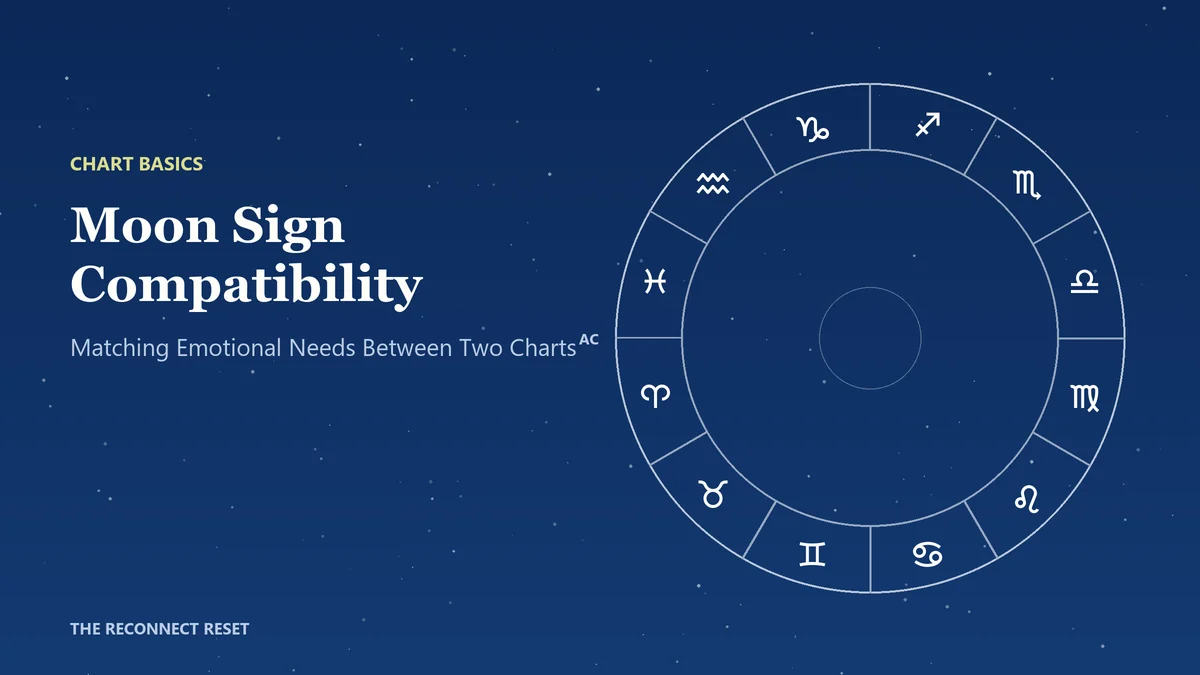
Moon sign compatibility compares the signs your Moons occupy to see how two people's emotional needs fit: what makes each of you feel safe, how you show care and how you handle upset. Moons in the same or complementary elements tend to understand each other easily; squares and oppositions ask for more translation.
This guide is for anyone comparing their chart with a partner's, a friend's or a relative's. It covers what each Moon element needs, how the distance between two Moon signs shapes the pairing, how the Moon works alongside the Sun and rising sign, and what to do with a pairing that looks difficult on paper.
How Moon Sign Compatibility Works
The Moon in astrology describes emotional needs, instinctive reactions and what feels like home. When two charts are compared, the relationship between the Moons is read as a measure of everyday ease: whether your moods make sense to each other, whether your ways of comforting each other actually land, and whether sharing a space feels natural.
That is why many astrologers weight the Moon heavily in long-term compatibility. Sun signs describe identity and purpose, which matter, but the Moon governs the texture of ordinary days, such as how you want to be spoken to when you are tired or how you celebrate small good news. Two people can admire each other's Sun signs and still feel misunderstood at the kitchen table.
Finding a Moon sign takes a birth date and, ideally, a birth time and place. The Moon spends only about two and a half days in each sign, so on a day when it changed signs the time decides which one applies.
What Each Moon Element Needs
The quickest way into compatibility is by element. Moon signs in the same element share an emotional language, and the four languages differ sharply.
Traditionally fire and air are grouped as active elements that feed each other, and earth and water as receptive ones that support each other. Those pairings tend to read as complementary even across different elements, while fire with water or earth with air can feel like two people speaking past each other. Here is what each element tends to need.
- Fire Moons (Aries, Leo, Sagittarius) — need enthusiasm, action and room to react; they process feelings by doing something and bounce back from upsets quickly.
- Earth Moons (Taurus, Virgo, Capricorn) — need stability, routine and practical care; they show love through effort and feel safest when life is predictable.
- Air Moons (Gemini, Libra, Aquarius) — need conversation, space and fairness; they process feelings by talking them through or thinking them over.
- Water Moons (Cancer, Scorpio, Pisces) — need closeness, loyalty and emotional attunement; they pick up moods quickly and feel hurt by distance.
Which Moon Signs Get Along: Counting the Signs Between Them
Beyond element, the number of signs between two Moons forms an aspect by sign, and each aspect has its own flavor. Exact degrees refine the reading, and schools differ on how wide an orb to allow, but the sign-to-sign relationship is the place to start.
No aspect is a verdict. A trine can go flat if neither person stretches, and a square can produce a couple who know each other unusually well because they had to learn. Here is how each distance is usually read.
- Same sign (conjunction, 0°) — instant recognition of each other's moods; the risk is that both react the same way at the same moment.
- Two signs apart (sextile, 60°) — friendly and cooperative, as with a Taurus Moon and a Cancer Moon; ease that still asks for a little effort.
- Three signs apart (square, 90°) — different needs in the same modality, as with Leo and Scorpio; friction that can sharpen understanding.
- Four signs apart (trine, 120°) — same element, as with Virgo and Capricorn; comfortable, mutual and easy to take for granted.
- Five signs apart (quincunx, 150°) — little in common, as with Aries and Virgo; asks for steady adjustment and patience.
- Six signs apart (opposition, 180°) — opposite signs, as with Cancer and Capricorn; strong pull and complementary strengths, with a tendency to polarize.
Sun, Moon and Rising: Comparing All Three
Moon-to-Moon is one strand of a chart comparison, not the whole of it. Astrologers also set one person's Moon against the other's Sun, a contact read as mutual recognition when the two fall in harmonious signs or conjoin. A Moon touching a partner's Venus is associated with affection and tenderness, while a Moon touching a partner's Saturn can describe either steadiness or a feeling of being judged.
The rising sign adds a third layer. It describes the manner each person meets the world with, and therefore pace, first impressions and daily style. A couple can share compatible Moons yet clash on tempo if one has Aries rising and the other Taurus rising. For a refresher on the three, see what the Sun, Moon and rising signs each describe.
When comparing all three, the useful move is cross-wise: your Moon with their Sun and rising, and their Moon with yours. Element and sign distance work the same way for each pair.
Moon Phase Compatibility
Moon phase compatibility is a separate idea. It looks at the phase the Moon was in when each person was born, which depends on the angle between the Sun and Moon in the chart, from the new Moon at 0 degrees through the full Moon at 180 and back again.
Each of the eight phases (new, crescent, first quarter, gibbous, full, disseminating, last quarter and balsamic) is read as a different orientation to life, from instinctive and starting fresh at the new Moon to reflective and releasing at the balsamic phase. Comparing birth phases is a looser, more symbolic layer than comparing signs, and it works best as a conversation starter rather than a score.
When Two Moons Look Hard on Paper
A difficult Moon pairing shows where translation is needed, not whether a relationship can work. An air Moon who needs to talk a feeling through and a water Moon who needs to be held through it can both be right; the friction comes from assuming the other person wants what you want.
A few reflective questions help more than any score. What does each of you do in the first hour after a hard day? How does each of you ask for comfort, and how do you know it has arrived? Which of your partner's reactions puzzles you most, and does their Moon sign describe it?
Used this way, Moon signs are a lens for understanding rather than a filter for choosing people. The rest of the comparison lives in the full chart, and how to read a birth chart covers where to find each piece.
Keep reading
- How to read a birth chart
- Astrology for beginners
- The 12 houses in astrology
- Sun, Moon and rising signs explained
Frequently asked questions
Is moon sign compatibility more important than sun sign compatibility?
Many astrologers give the Moon more weight in long-term relationships, because it describes emotional needs and daily habits, while the Sun describes identity and purpose. Neither works alone, though. A full comparison looks at the Sun, Moon, Venus, Mars, the rising sign and the aspects between two charts, so a single mismatch rarely decides much.
Do you need a birth time to find your moon sign?
Often, but not always. The Moon spends about two and a half days in each sign, so on most dates it stays in one sign all day and the date alone is enough. If it changed signs on your birthday, the birth time and place decide which sign applies, and the time also sets your rising sign.
What are the most compatible moon signs?
Moons in the same element are usually read as the easiest match, such as Cancer with Scorpio or Pisces, or Taurus with Virgo or Capricorn. Fire with air and earth with water are also considered complementary. Easy does not mean better, though, and some of the steadiest pairings involve Moons that had to learn each other's language.
Can opposite moon signs be compatible?
Yes. Opposite Moon signs, such as Aries and Libra or Taurus and Scorpio, sit 180 degrees apart and share a modality, so they look at the same theme from two sides. They are often read as strongly drawn to each other and complementary. The common challenge is hardening into fixed roles instead of borrowing a little of each other's style.
How does a moon sign compatibility calculator work?
A calculator converts each birth date, time and place into planetary positions, finds both Moon signs and then scores them, usually by element and by the aspect the two Moons form. Some add Sun, Venus and rising-sign comparisons. The result is only as accurate as the birth data entered, and it cannot weigh the rest of two charts the way a full reading does.
New readings and guides by email
The title, a short excerpt and a link for each new reading or guide on this site. At most two emails a month.