The 12 Houses in Astrology: What Each One Actually Means
The short answer
The houses in astrology are twelve sections of a birth chart, each covering an area of life, from self and resources to home, partnership, career and the hidden. Built from the ascendant, they need an exact birth time. A sign describes a style and a planet a function; the house is traditionally read as where in life that function shows up.
A sign describes a style. A planet describes a function. Neither one tells you where in your life that style and function actually show up – and that is the one job the houses do. The same Venus in the same sign lands differently depending on whether it falls in the house of home and family or the house of career and reputation.
There are twelve houses in a birth chart, each covering a distinct area of life, and every chart has all twelve whether or not a planet sits in them. Here is what each one covers, how they are grouped, and why the hour of your birth is what makes this part of a reading personal rather than generic.
Sign, planet, house: three different questions
It helps to keep these separate, because popular astrology often blurs them:
- The planet is the what – Venus is affection and value, Mars is drive and assertion, Mercury is communication.
- The sign is the how – the same Venus behaves differently in reserved Capricorn than in expressive Leo.
- The house is the where – which room of your life that planet’s energy is decorating. Career, home, partnership, health, friendship, and so on.
A full chart reading layers all three onto every planet. This piece is only about the third layer, because it is the one that turns a list of planetary meanings into an actual map of a life.
Take Venus in Leo as an example. In the 4th house, that placement is usually read toward home and family – a warmth expressed through hosting, decorating, or the atmosphere someone builds at home. In the 10th house, the same Venus in the same sign is read toward career and public role instead – charisma that shows up in front of an audience or a client rather than around a dinner table. The planet and the sign have not changed at all; only the house has, and the reading changes with it.
What a house needs to be calculated: your birth time
Sun and moon sign only need a birth date. Houses need a birth time, because the house system is built from the exact degree of the zodiac rising on the eastern horizon at the moment you were born – your ascendant, covered in more depth in how to find your rising sign. That degree becomes the start of the first house, and the rest of the wheel is divided out from there.
Because the sky rotates through roughly one full sign every two hours, a birth time that is off by even twenty or thirty minutes can shift which house a planet near a boundary falls into. A chart calculated from an approximate or rounded birth time is a reasonable starting point, but a planet sitting close to a house cusp is exactly the kind of detail worth double-checking against a birth certificate or hospital record before reading too much into it.
The three groups: angular, succedent, and cadent
Rather than twelve unrelated boxes, the houses fall into three groups of four, and the group a house belongs to shapes how directly it tends to show up.
| Group | Houses | General character |
|---|---|---|
| Angular | 1st, 4th, 7th, 10th | The most immediate and visible. Identity, home, partnership, career – the load-bearing walls of a life. |
| Succedent | 2nd, 5th, 8th, 11th | What is built and sustained from the angular houses. Resources, creativity, shared assets, community. |
| Cadent | 3rd, 6th, 9th, 12th | Processing and adapting. Learning, routine, belief, the unconscious – the houses that digest experience. |
The angular houses sit at the four corners of the wheel – the ascendant, descendant, midheaven, and lowest point of the chart – which is why practitioners tend to weigh a planet parked in one of them more heavily than the same planet in a succedent or cadent house. It is not that the other eight houses matter less; it is that the angular four tend to describe the parts of a life other people can actually see from the outside.
Why two calculators can place the same planet in different houses
Type an identical birth date, time, and place into two different chart calculators and it is possible to get two different house placements for a planet sitting near a cusp. That is not a bug in one of them – it usually comes down to which house system was used. Whole sign houses, one of the oldest methods, simply lets each house match one full zodiac sign. Placidus and several other quadrant systems instead divide the sky into houses of unequal size based on the exact latitude of the birth location, which is more mathematically involved and can shift a borderline planet into the neighbouring house. Neither is treated as more correct; they are different conventions for slicing the same sky, and it is worth knowing which one a calculator used before assuming a placement is settled.
Houses 1 through 6: the inner half
The houses below the horizon – roughly the bottom half of the wheel – are traditionally read as the more private, personal side of the chart: the self, and the immediate people and habits around it.
- 1st house – Self. Identity, appearance, first impressions, how you initiate. This is the house the ascendant itself belongs to.
- 2nd house – Resources. Money, possessions, and also self-worth – what you consider valuable, including in yourself.
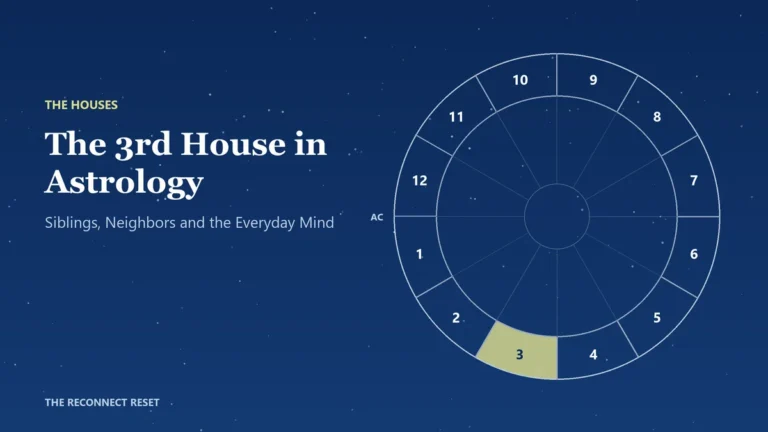
- 3rd house – Communication. Everyday speech, short trips, siblings, and the immediate environment – the version of Mercury’s domain that is local rather than long-distance.
- 4th house – Home. Family, roots, one’s sense of belonging, and often read as the more private parent.
- 5th house – Expression. Creativity, romance, play, and what is made for its own sake rather than for use.
- 6th house – Routine. Daily habits, work as a practice rather than a career, and the ordinary maintenance a life runs on.
Houses 7 through 12: the outer half
The top half of the wheel is read as the more public and interpersonal side – the parts of life built with, through, or in relation to other people and larger structures.
- 7th house – Partnership. Marriage, business partners, and open one-to-one relationships generally – directly opposite the 1st house, self met by other.
- 8th house – Shared resources. Joint finances, inheritance, and traditionally the house of transformation and what is deeply merged with another person.
- 9th house – Belief. Higher education, long-distance travel, philosophy, and the search for meaning beyond the immediate environment.
- 10th house – Career. Public role, reputation, vocation, and often read as the more public parent.
- 11th house – Community. Friendship, groups, and long-term hopes held in common with others rather than alone.
- 12th house – The unconscious. Rest, retreat, and what happens out of view – traditionally the most private and least literal house of the twelve.
An empty house is not an empty life
Most charts have several houses with no planet in them at all, and that is normal, not a gap to worry about. An empty house is still read – it just leans on the sign on its cusp and the planet that rules that sign, rather than on a planet sitting inside it directly. A 7th house with nothing in it still describes a real approach to partnership; it is simply read through where its ruling planet sits elsewhere in the chart, rather than being silent.
Reading your own chart
Once you know your Sun, Moon, and rising sign – covered in sun sign, moon sign, and rising sign – the houses are what turns those three placements, plus everything else in the chart, into a structure rather than a list. Before reading too much into any single house, it helps to have the basics right:
- Exact birth time, ideally from a birth certificate or hospital record rather than a rounded family memory.
- Birth location, since the houses are calculated from the latitude and longitude of where you were born, not just the date.
- A note of which house system a calculator used, so a borderline placement is not read as more certain than it is.
- Which house has the most planets in it, since a crowded house tends to carry outsized weight in how the rest of the chart is described.
Treat any single house or placement as one layer of a much larger picture rather than the whole story. A chart is read as a set of relationships between houses, signs, and planets together, not as any one of the three in isolation.
Frequently Asked Questions
What is the difference between a sign and a house in astrology?
A sign describes the style or manner of a planet's expression – for example, direct or reserved. A house describes which area of life that planet's energy shows up in, such as career, home, or partnership. Both layer onto the planet itself to build a full reading.
Do I need my exact birth time to know my houses?
Yes. Sun and moon sign can be found from a birth date alone, but the houses are built from the ascendant, which depends on the exact time and location of birth. A birth time that is off by even twenty or thirty minutes can shift which house a planet near a cusp falls into.
What does it mean if a house has no planets in it?
It is completely normal and does not mean that area of life is missing or unimportant. An empty house is still read through the sign on its cusp and the planet that rules that sign, wherever that planet sits elsewhere in the chart.
Which houses matter most in a reading?
The angular houses – 1st, 4th, 7th, and 10th – tend to be read as the most immediately visible, covering identity, home, partnership, and career. A house with several planets in it in your own chart is also usually worth extra attention, since it tends to carry outsized weight in how the rest of the chart is described.
Is a house placement a prediction about what will happen in that area of my life?
No. A house placement describes a traditional theme to use as a lens for self-reflection, not a forecast of events or a guarantee about how a situation will turn out. If you are facing a real decision or concern in one of these areas, that is worth working through with a qualified professional rather than relying on a chart reading.
New readings and guides by email
The title, a short excerpt and a link for each new reading or guide on this site. At most two emails a month.