The 2nd House in Astrology: Earnings, Possessions and Self-Worth
The short answer
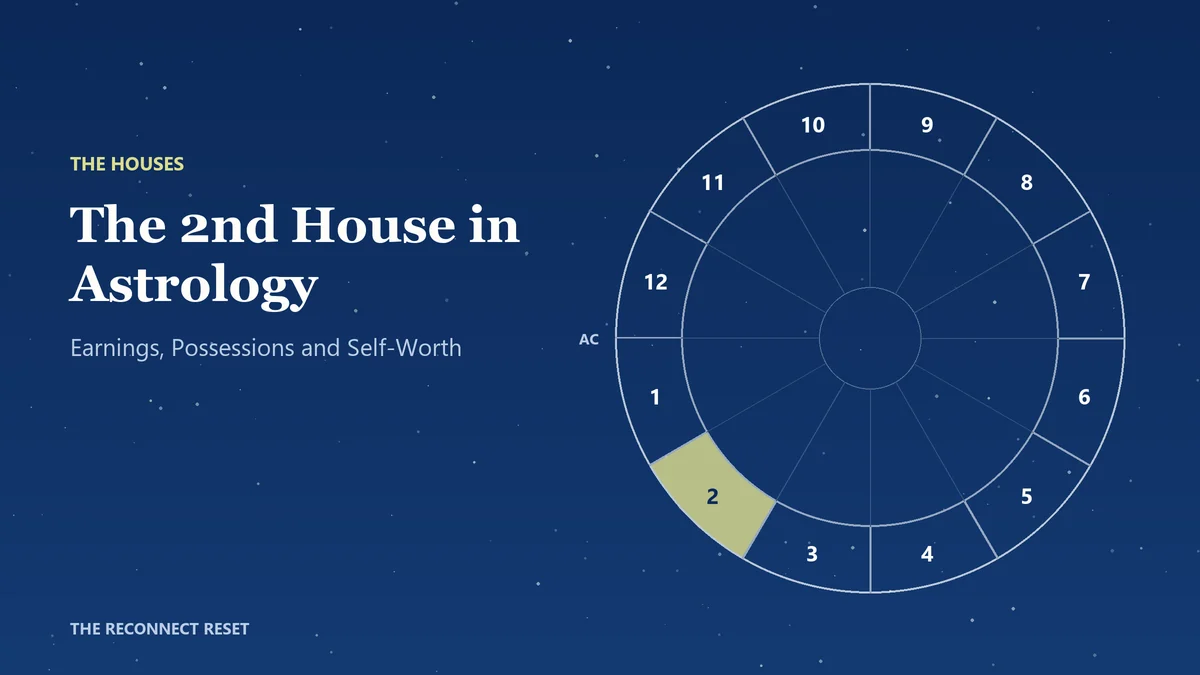
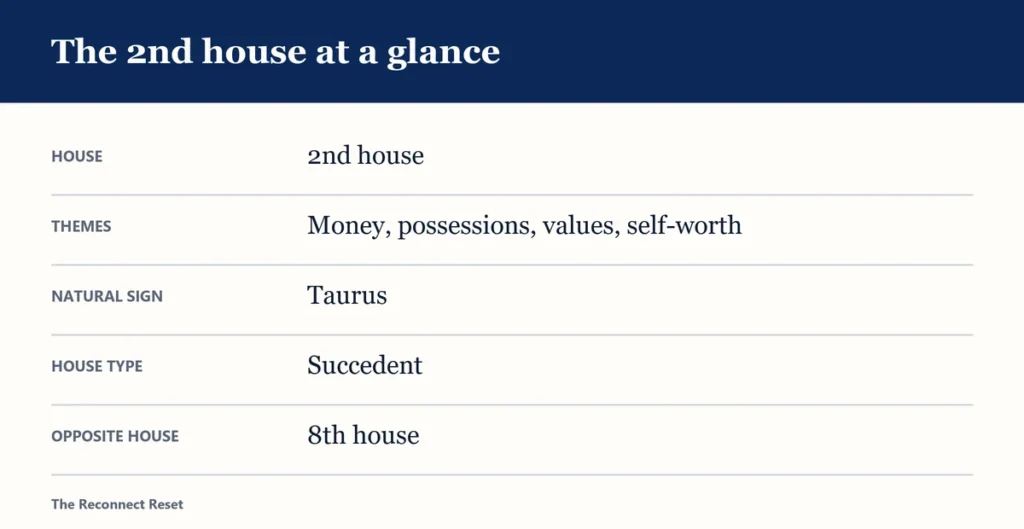
In 2nd house astrology, the second house describes what you have and what you value: earned income, possessions, practical skills and the sense of worth underneath them. It shows your relationship with security rather than a dollar figure, and it is read through its cusp sign, its ruler and any planets inside.
Use this page as a reference for the second house of any chart. It explains what the house denotes, how it differs from the 8th, how its sign and ruler are read, and what each kind of planet tends to say about earning and keeping.
2nd House Astrology: What the House Denotes
The second house covers movable resources: income you earn, money you save, the things you own and the practical skills that let you get more of them. Older texts call it the house of livelihood. Modern astrology widens it to values and self-worth, on the logic that what you will work for and hold on to says a good deal about what you think you deserve.
It is a succedent house, following the angular 1st, and succedent houses are read as places where what the angles start gets stabilized and accumulated. Its natural sign is Taurus and its natural ruler Venus, which gives the house its link to comfort, the senses and things that last. Food, clothing, tools and a well-kept household budget all belong here.
The 2nd house describes an approach to resources, not an amount. Two people with the same placement can earn very different incomes; what they tend to share is a style of earning, spending and deciding what counts as enough.
Your Own Resources Versus Shared Ones
Every house is read against its opposite, and the 2nd faces the 8th. The 2nd is what you earn and own in your own name; the 8th is what you share with or receive through others, such as a partner's income, loans, debts, taxes and inheritance. Put simply, the 2nd is your paycheck and the 8th is the joint account.
The axis also runs through intimacy. The 2nd house is self-possession, the ability to feel complete on your own terms, while the 8th is merging with someone else and the exposure that comes with it. Planets on one side of the axis often describe a need that the other side has to balance.
Reading the Sign on the 2nd House Cusp
The sign on the cusp describes your default style with money and possessions. Fire signs tend to earn and spend with enthusiasm, earth signs build slowly, air signs value ideas and connections, and water signs attach feeling to what they keep.
Whatever the sign, check whether the cusp falls late in one sign with most of the house in the next. In quadrant house systems that happens often, and both signs then add to the picture. Here are the cusp signs people ask about most.
- Aries on the 2nd — earning through initiative and speed; spending decisions made fast and sometimes regretted fast.
- Leo on the 2nd — pride in what you own and generosity with it; income tied to creativity, visibility or leadership.
- Scorpio on the 2nd — privacy about money, intense focus when building reserves, a strong instinct to control resources.
- Sagittarius on the 2nd — an expansive, optimistic relationship with money, often linked to teaching, travel or publishing.
- Aquarius on the 2nd — unconventional ways of earning, values shaped by principle and a detached view of possessions.
Element on the 2nd house cusp and its approach to resources
| Element on the cusp | Signs | Typical approach to resources |
|---|---|---|
| Fire | Aries, Leo, Sagittarius | Earns with enthusiasm, spends on experience and self-expression |
| Earth | Taurus, Virgo, Capricorn | Builds slowly, values quality, durability and savings |
| Air | Gemini, Libra, Aquarius | Values ideas, contacts and flexibility; earns through communication |
| Water | Cancer, Scorpio, Pisces | Attaches feeling to possessions; security is emotional as well as material |
Where the 2nd House Ruler Lands
Find the planet that rules the sign on your 2nd house cusp, then find its house. That house is traditionally read as a source of income or as the area of life your resources flow toward. With Gemini on the 2nd and Mercury in the 9th, earning through teaching, writing or travel is the classic reading; with Capricorn on the 2nd and Saturn in the 6th, the theme is steady daily work.
The reverse placement matters too. When the 1st house ruler, your chart ruler, sits in the 2nd, identity gets bound up with what you build and own. This is often read as someone who needs to earn their own way to feel like themselves, and whose sense of self rises and falls with their finances until they learn to separate the two.
The full method of tracing rulers from house to house is set out in how to read a birth chart, and it works the same way for every house.
Planets in the 2nd House
Planets in the second house describe what you value and how you go about getting it. Read them with their sign and aspects, and keep in mind that a planet's condition here speaks to attitude and effort, never to a bank balance.
The Sun or Moon in the 2nd ties identity or emotional security closely to resources, so a stable income can feel like a stable self. Mercury suggests earning with words, trade or ideas; Venus a taste for beautiful things and an easy relationship with comfort; Mars an energetic, competitive earner who may also spend on impulse.
Jupiter here is traditionally a generous placement, associated with abundance and with spending as freely as earning. Saturn describes caution, slow accumulation and sometimes early scarcity that shapes later habits. Uranus brings irregular or unconventional income, Neptune idealism or vagueness about money, and Pluto an all-or-nothing relationship with control.
A 2nd House Stellium and an Empty 2nd House
With three or more planets in the 2nd, values and resources become a central theme of the chart: earning, collecting, building and questioning what is worth having. This concentration often describes real practical talent alongside a lifelong conversation about self-worth. See how a stellium shapes a chart for how such clusters are weighed.
An empty 2nd house does not mean a shortage of money or of interest in it. It means no single planet is speaking loudly there, so the cusp sign and the house and condition of its ruler carry the reading instead. Many people with busy financial lives have no planets in the 2nd at all.
Keep reading
- The 12 houses in astrology
- How to read a birth chart
- Stellium in astrology
- The 1st house in astrology
Frequently asked questions
What does the 2nd house in astrology denote?
The second house denotes your own resources: earned income, savings, possessions and the practical skills that produce them. Modern astrologers add personal values and self-worth. It describes your relationship with money and security, meaning how you earn, spend and decide what is enough, rather than an exact figure or any promise of wealth.
Which planet rules the 2nd house?
Venus is the natural ruler of the 2nd house, because Taurus is the second sign of the zodiac. In a specific chart, the ruler is whichever planet rules the sign on the 2nd house cusp: Mercury for Virgo, Jupiter for Sagittarius, Saturn for Capricorn. Its house placement is traditionally read as a source of income or the place resources go.
What does the 1st house ruler in the 2nd house mean?
When the ruler of your rising sign sits in the second house, identity and resources become linked. It is often read as someone who feels most like themselves when self-supporting, and who expresses who they are through skills, possessions and personal values. The growth edge is a sense of worth that does not depend on the latest balance.
What is a 2nd house profection year?
Annual profections assign one house to each year of life, starting with the 1st at birth. The 2nd house year falls at ages 1, 13, 25, 37, 49, 61, 73 and 85. It is traditionally read as a year that brings income, possessions and self-worth into focus, with the ruler of the 2nd house sign serving as lord of the year.
New readings and guides by email
The title, a short excerpt and a link for each new reading or guide on this site. At most two emails a month.