The 9th House in Astrology: Belief, Study and Far Horizons
The short answer
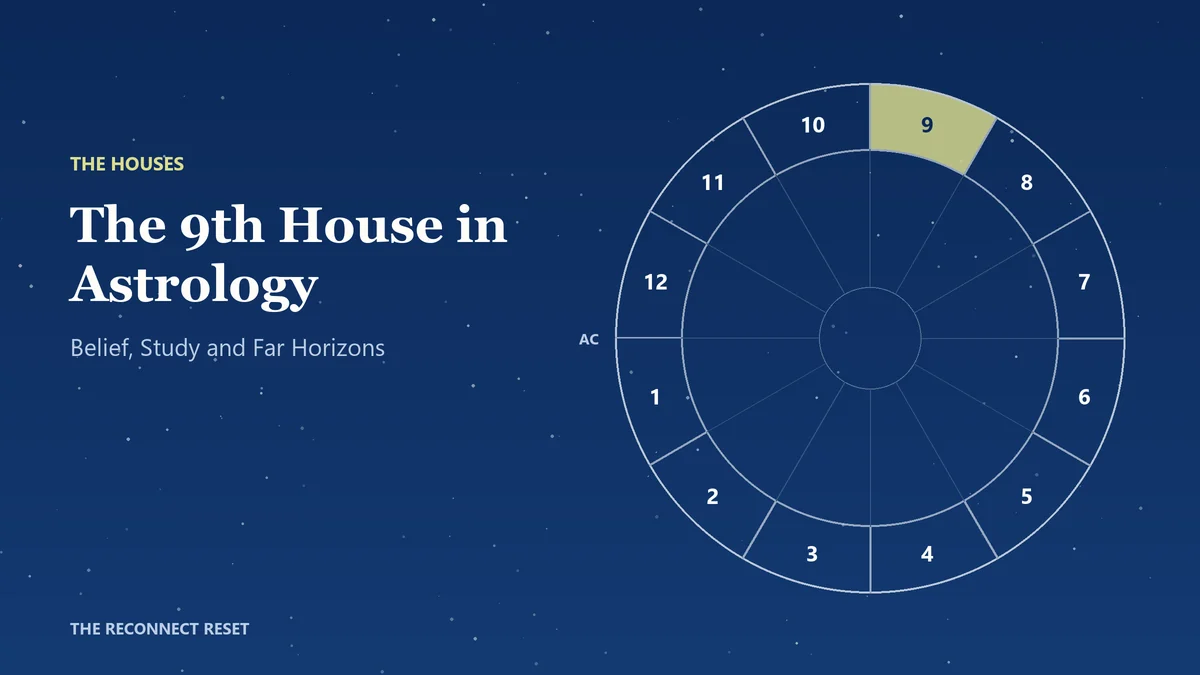
In 9th house astrology, the ninth house covers the search for meaning: long-distance travel, higher education, religion and philosophy, law, publishing, teachers and the beliefs you live by. It is read as the house of the wider view, where a chart describes how you reach beyond what you were raised with.
Ask someone what they think life is for, and you are asking about their 9th house. This page covers what the house denotes, its older names, how it differs from the 3rd house across the chart, how to read its sign and lord, what planets there describe, and what an empty ninth suggests.
What the 9th House Denotes
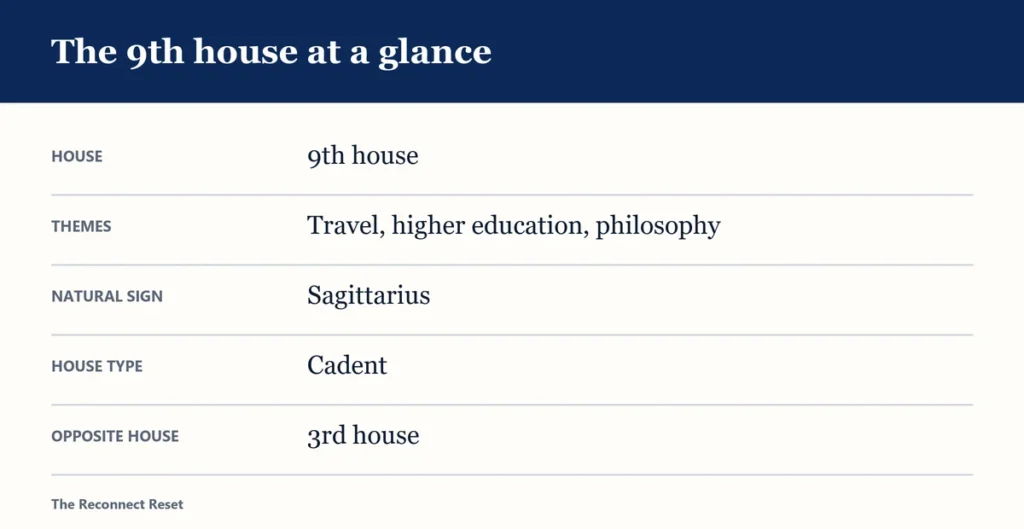
The ninth is a cadent house with Sagittarius as its natural sign and Jupiter as its natural ruler. Everything in it involves distance of some kind: physical distance through travel and foreign places, or mental distance through study, faith and big-picture thinking that takes you past the familiar.
It also has a few less obvious duties. Counted as the third house from the 7th, it describes a partner's siblings, which is why it is often read for in-laws. And because it governs codes people live by, it covers law, courts and ethics as well as religion.
- Travel — long journeys, living abroad, foreign cultures and languages
- Higher learning — university, graduate study, any serious course of study
- Belief — religion, philosophy, ethics, a personal sense of meaning
- Teachers — mentors, professors, spiritual guides and gurus
- Publishing and law — books, broadcasting, courts and legal matters
The House of God: Older Meanings
Hellenistic astrologers called the 9th the house of God and placed the joy of the Sun here, the house where the Sun was said to be most at home. It was linked to divination, dreams, religious duty and long voyages, which in the ancient world meant real risk and real transformation.
In Vedic astrology the ninth is one of the most fortunate houses. It is read for dharma, a person's right path, and for fortune, and it is also the house of the father and of the guru, the teacher who passes wisdom on. That is the reason many searches ask whether the 9th house shows the father: in Jyotish it does, while Western astrology usually reads parents through the 4th and 10th.
The 3rd House vs the 9th House
The 3rd and 9th sit opposite each other and divide the mind's work between them. The 3rd is the everyday mind: errands, messages, neighbors, siblings and the information you need today. The 9th is the mind reaching outward: the questions that do not have quick answers, and the systems of thought built to answer them.
A simple test separates them. Learning to drive is 3rd house; deciding what kind of life is worth driving toward is 9th house. Most charts need both, and planets on one side of this axis are often read as asking for development of the other. The table on this page lays the contrast out side by side.
The 3rd house and the 9th house compared
| Theme | 3rd house | 9th house |
|---|---|---|
| Mind | Everyday thinking and facts | Philosophy, belief and meaning |
| Travel | Short trips and commutes | Long journeys and life abroad |
| Learning | Early schooling and practical skills | Higher education and deep study |
| People | Siblings and neighbors | Teachers, mentors and in-laws |
| Words | Messages, notes and conversation | Books, publishing and teaching |
9th House Astrology: Reading the Sign and Its Lord
The sign on the 9th cusp describes the style of your beliefs and how you approach learning. The planet that rules that sign, called the lord or ruler of the 9th, shows where those beliefs lead in practice, by its own house and sign. If the ruler sits in the 10th, for example, study and principle often feed a career; in the 4th, faith and learning are tied to home and family.
Gemini on the 9th, a common search, describes a mind that collects philosophies rather than settling on one, learns through conversation and may study several subjects or languages. Mercury's placement then shows where that curiosity is applied. Scorpio on the 9th suggests beliefs forged in crisis and tested hard; Taurus suggests a practical, sensory faith that values what lasts.
Which Planets Show Up in the 9th
Any planet can sit here; the question is what it adds to the house's themes of meaning, distance and learning.
The Sun, Moon and personal planets
The Sun here is in its traditional joy, describing identity built around ideas, travel or teaching. The Moon suggests emotional ease in foreign places or a need to feel that life means something. Mercury favors study and writing, Venus brings love of culture and sometimes love found abroad, and Mars describes conviction that can turn into crusading.
Jupiter and Saturn
Jupiter, the house's natural ruler and the planet called guru in Vedic astrology, is traditionally read as very comfortable here: generous beliefs, luck through learning, a teacher's instinct. Saturn asks for structure, so belief may be earned slowly, through serious study or a long period of questioning.
Outer planets and the nodes
Uranus describes unconventional beliefs or sudden changes of worldview; Neptune, mystical or idealistic faith; Pluto, convictions that transform the person who holds them. With the North Node in the 9th and the South Node in the 3rd, known as Rahu and Ketu in Vedic astrology, growth is read as moving from local talk toward a larger philosophy.
Other House Lords in the 9th, and an Empty 9th
When the 1st house ruler lands in the 9th, the self is described as growing through travel, study or a search for meaning; these people often feel most themselves away from where they started. A 2nd house ruler in the 9th links income and values to teaching, publishing, law or foreign trade. A 3rd house lord in the 9th connects everyday communication with higher learning, often describing writers and teachers.
An empty 9th house is common and means nothing is lacking. Read it through its cusp sign and that sign's ruler, and through transits that pass through it. The house still describes your beliefs and your relationship with the wider world, just without a planet adding emphasis. For how the 9th fits among the others, see our guide to the 12 houses in astrology.
Keep reading
Frequently asked questions
Which planet rules the 9th house?
Jupiter is the natural ruler of the 9th house, through its link with Sagittarius, the ninth sign. In an individual chart, the ruler of the 9th is the planet that rules whichever sign sits on its cusp. Hellenistic astrology also placed the Sun's joy in the 9th, so the Sun is considered at home there.
Does the 9th house represent the father?
In Vedic astrology, yes: the ninth house is read for the father, along with teachers, dharma and fortune. Western astrology usually reads the parents through the 4th and 10th houses instead, and different schools disagree about which of those two is the father. If you work with both systems, keep the distinction in mind.
What does the 1st house lord in the 9th house mean?
When the ruler of your rising sign sits in the 9th house, the self is traditionally described as growing through learning, travel and belief. It often suggests a person who defines themselves through ideas, studies throughout life or feels most alive in unfamiliar places. The ruler's sign and aspects show how easily that expansion comes.
What is the 9th house called?
The 9th is often called the house of philosophy, higher learning or long-distance travel. Hellenistic astrologers named it the house of God, and Vedic astrology calls it the dharma or bhagya house, the house of right path and fortune. Its opposite, the 3rd house, was called the house of the Goddess.
New readings and guides by email
The title, a short excerpt and a link for each new reading or guide on this site. At most two emails a month.