Astrocartography: What Your Chart Says About Where to Live
The short answer
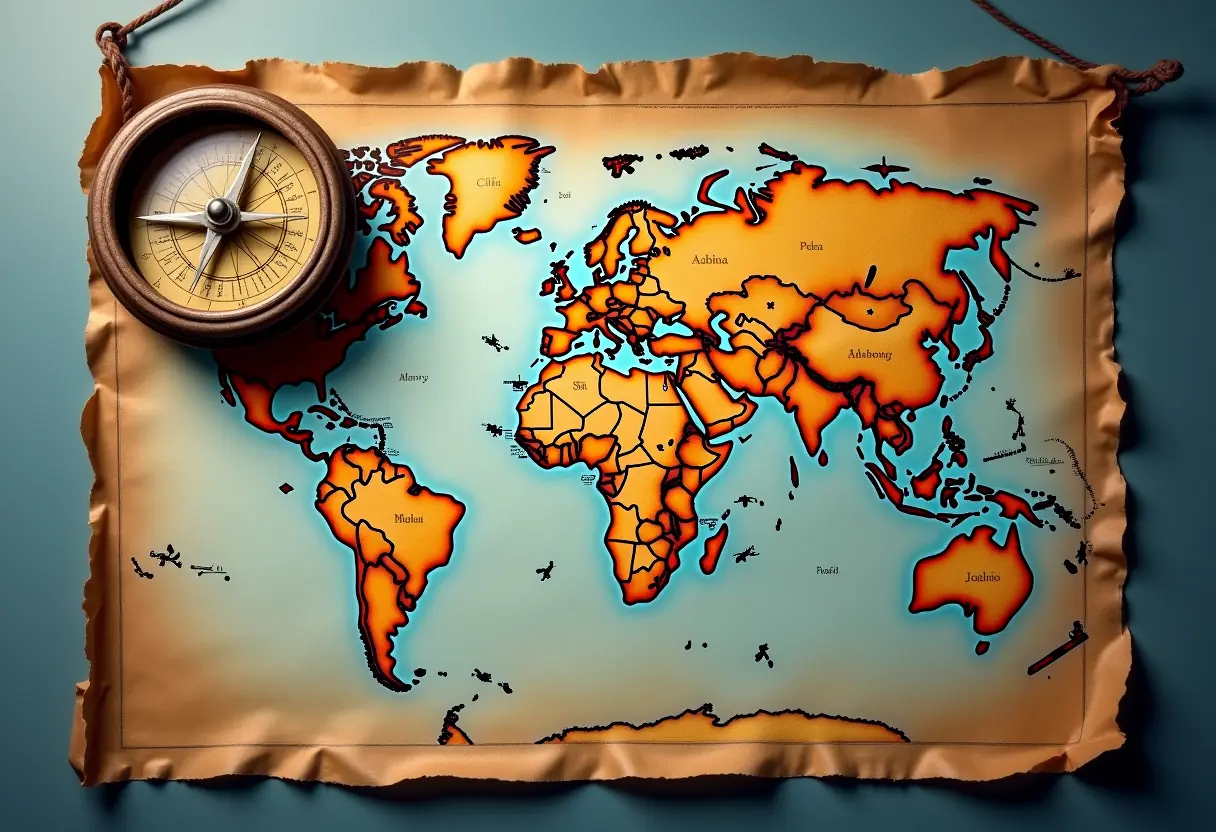
Astrocartography recalculates the angles of your birth chart for every longitude on Earth and plots each planet as lines on a world map. A line is traditionally read through that planet's usual themes, shaded by the angle it crosses, as a place where its influence is thought strongest. It is a lens for reflection, not a relocation plan.
Astrocartography takes the birth chart you already have and asks a different question of it: not just who the planets say you are, but where in the world their influence is thought to be strongest. It does this by recalculating your chart’s angles for every longitude on Earth and plotting the results as lines on a map, so a planet that sits quietly in one house at home can land right on your horizon in another country.
The technique has picked up real momentum lately among travellers and people planning a move, partly as a byproduct of more people being able to work from anywhere. This piece explains where it came from, how the lines are actually built, how to read one without overreading it, and where the technique’s honest limits are.
What Astrocartography Actually Shows
Your birth chart is calculated for one specific place: wherever you were born. The positions of the Sun, Moon and planets against the horizon and the meridian at that moment are what give you your rising sign, your midheaven, and the rest of the chart’s structure.
Move that same birth moment to a different longitude, and those angles change, because the horizon and meridian themselves are different there. Astrocartography runs that recalculation for the entire globe at once and marks, for each planet, every place on Earth where it would sit exactly on one of the four angles — rising, setting, at the top of the chart, or at the bottom. The result is a set of curved lines running across a world map, one pair of lines per planet.
A place near one of your lines is traditionally read as a location where that planet’s themes are more pronounced for you personally — not guaranteed, not the same for everyone who stands there, but worth paying attention to as a lens, the same way a placement in your natal chart is.
The technique itself is younger than most of what this site covers. The American astrologer Jim Lewis created the first hand-drawn version of it in September 1976, building on older locational-astrology ideas and turning them into the world-map format still used today. After his death in 1995, colleagues who had trained under him kept his teaching materials in circulation, which is part of why the terminology and the four-angle structure have stayed fairly consistent across different software and practitioners since.
How the Map Is Built From Your Birth Data
The calculation needs the same three things any accurate chart needs: your date of birth, your time of birth to the minute if possible, and your birthplace. Time matters more here than almost anywhere else in astrology, because the angles are exactly what the whole map is built from — a birth time that is off by even fifteen or twenty minutes can shift a line enough to move it away from a city you were checking.
If you only have an approximate birth time, treat the resulting map as a rough sketch rather than a precise one, and be cautious about reading fine detail into which side of a specific city a line falls on.
Most people generate a map through an astrology software tool or a practitioner, entering their birth data once. The output is a world map with a set of gently curving lines for each of the traditional planets, plus the Sun and Moon, layered over the countries and cities you might be considering. Where two lines physically cross on the map, that intersection is traditionally read as a small area where both planets’ themes blend — practitioners sometimes call these crossing points parans, and they’re generally treated as worth a closer look precisely because two influences are said to meet there rather than one.
The Planetary Lines, Read Simply
Each planet’s line is generally read through the themes that planet already carries in the rest of astrology — the same associations used for its house placement in your natal chart, just applied to a place instead of a life area.
| Line | What it’s traditionally associated with |
|---|---|
| Sun | Visibility, vitality, a sense of being seen or in the spotlight |
| Moon | Emotional comfort, domestic life, a feeling of being at home |
| Venus | Ease, romance, aesthetics, social warmth |
| Mars | Drive and ambition, but also friction, competition, a faster pace |
| Jupiter | Growth, opportunity, expansion, good fortune in the traditional sense |
| Saturn | Structure, discipline, responsibility — often read as demanding rather than easy |
None of these are promises. A Venus line is not a guarantee of romance, and a Saturn line is not a warning to avoid a place — plenty of people build steady, meaningful lives on their Saturn lines precisely because of the structure and discipline they ask for. Read the table as a starting lens for reflection, the way you would a house placement, not as a forecast.
The Four Angles Change What a Line Means
A planetary line does not just sit on the map on its own — it crosses one of the same four angles that structure your natal chart: the Ascendant, the Descendant, the Midheaven, or the IC. Which angle a given line touches at a given place changes the flavour of the reading, the same way a planet’s house placement changes its reading at home.
A planet on your Midheaven in a location tends to be read as more visible in your public life and career there — the same association the Midheaven carries in your natal chart. The same planet crossing your IC in a different city leans toward home, family and private life instead. A line on the Ascendant is read as coloring how you come across and how you experience yourself day to day in that place; on the Descendant, it leans toward partnerships and the people you meet there.
This is why the same planet can read differently in two cities that both sit near one of its lines — it is genuinely a different angle each time, not a contradiction in the technique.
What This Tool Is Not
Astrocartography is a lens for reflection, not a relocation plan, a career guarantee, or a substitute for the practical research an actual move deserves. It says nothing reliable about visa rules, job markets, cost of living, safety, or whether you’ll personally like a place — those are questions only real research and, ideally, real time spent there can answer.
It also is not a prediction that something specific will happen if you go, and it is not financial, medical or legal guidance of any kind. Traditional astrology treats a line the way it treats any placement: as a traditional association worth holding lightly, not a certainty about your future — and a map that says nothing about a place you’re already drawn to for solid practical reasons should never outweigh those reasons.
How to Actually Use a Map
Used well, a map is a starting point for noticing, not a set of instructions to follow.
- Start with the practical shortlist you’d make anyway — job, budget, climate, family, community — and use the map to add a layer of reflection on top of it, not to replace it.
- Give more weight to lines near places you were already seriously considering than to lines in places you have no other reason to go.
- Where possible, visit before committing to a permanent move, and treat a short trip as a way to test the reading against how the place actually feels.
- Hold the reading loosely. The traditional meaning of a line is a lens for self-reflection, in keeping with how every placement on this site is meant to be read — never a promise about how your life there will turn out.
Read this way, astrocartography does what most of astrology’s better-known tools do at their best: it gives you a structured way to ask what you actually want from a place, before you go looking for it on a map.
A Related Technique: Local Space Astrology
Astrocartography isn’t the only way locational astrology approaches this question, and it helps to know the difference so the two don’t get confused. Where astrocartography asks which regions of the whole globe amplify which planet for you, local space astrology stays closer to home: it draws a set of lines radiating outward from your birthplace like spokes on a wheel, each one pointing in the compass direction a given planet sat in at the moment you were born.
The two are generally read as complementary rather than competing. Local space tends to be most useful for orienting yourself within a place you’ve already chosen — which direction to live in relative to where you already are — while astrocartography is better suited to comparing places on opposite sides of the world. If your birth data throws up a location worth a closer look, a local space reading of that same place is a natural next step rather than a contradiction of the first map.
Frequently Asked Questions
Do I need an exact birth time for astrocartography to work?
You need one for the map to be precise. The lines come directly from your chart's angles, which are calculated from your exact birth time, so an approximate time can shift a line enough to change which city it appears to cross. Treat a map made from an uncertain birth time as a rough sketch rather than something to read down to street level.
Does living on a planet's line guarantee that theme in my life?
No. A line is a traditional association to hold as a lens for reflection, the same way a placement in your natal chart is, not a prediction or a guarantee. Plenty of people build satisfying lives on lines that are traditionally read as more demanding, like Saturn, and plenty of people never notice the theme of a line they're living on at all.
What's the difference between an astrocartography line and a relocation chart?
A world map with astrocartography lines shows every planet's line across the whole globe at once, so you can scan many places in one view. A relocation chart instead recalculates your full birth chart for one single place, the way a solar return recalculates it for one date, and is generally used once you already have a specific location in mind.
Should I make a big move based only on an astrocartography reading?
It's best used alongside the practical research a real move deserves, not in place of it. Job prospects, cost of living, visa requirements and how a place actually feels to live in are questions the map doesn't answer, so treat it as one lens among several rather than the deciding factor.
New readings and guides by email
The title, a short excerpt and a link for each new reading or guide on this site. At most two emails a month.