Midheaven in Astrology: What Your MC Really Reveals
The short answer
The Midheaven, or MC, is the highest point in a birth chart and in most house systems marks the cusp of the 10th house. Finding it takes your exact birth time and place. In astrology it is traditionally read as a marker of reputation, public direction and the role you grow into in other people's eyes, rather than a specific job.
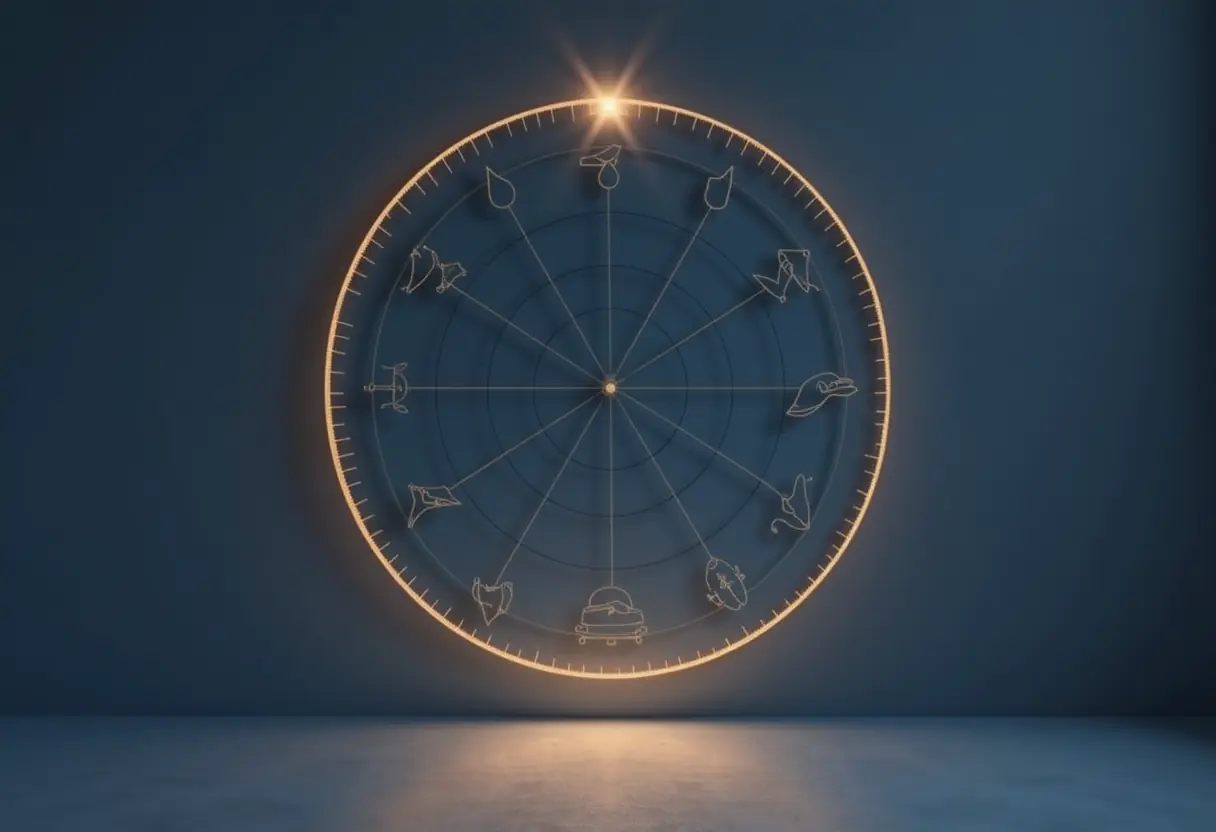
The Midheaven, often shortened to MC, is the highest point in your birth chart — the spot the Sun would occupy at your exact local noon on the day you were born. In the language of astrology it’s traditionally read as a marker of reputation, direction, and the role you grow into in the eyes of other people, distinct from the more private, personal territory of your Sun or Moon sign.
Unlike your Sun sign, the Midheaven depends on the exact time and place you were born, not just the date. That’s why it rarely shows up in a quick horoscope and why two people born on the same day can have completely different Midheavens.
What the Midheaven Actually Is
A birth chart is built from four angles — the Ascendant, Descendant, Midheaven, and Imum Coeli (IC) — which mark the four cardinal points of the sky at the moment of birth. The Ascendant sits on the eastern horizon; the Midheaven sits at the top of the chart, directly overhead. In most house systems, the Midheaven also marks the cusp, or starting edge, of the 10th house — traditionally the house associated with career, status, and public life.
Because the Midheaven and the 10th house are so closely linked, the two are often discussed together. The 10th house is the broader territory; the Midheaven is the specific degree and sign that anchors it.
The angles are calculated differently from the planets. Where a planet’s position depends only on the date, the angles depend on the precise moment and the exact latitude and longitude of the birth location, because they track the sky’s rotation relative to that one spot on Earth. That’s also why the Midheaven can land a little differently across house systems — worth knowing if you compare two calculators and get slightly different answers.
How to Find Your Midheaven
You’ll need your exact birth time — ideally to the minute, pulled from a birth certificate or hospital record — along with your birth date and location. Even a 15-20 minute error can shift the Midheaven into a neighboring sign, since it moves through the entire zodiac roughly once every 24 hours.
Most birth chart calculators display the Midheaven as “MC” near the top of the wheel. If you’ve already generated a full chart for another reason, such as reading your rising sign, your Midheaven will be sitting right there in the same report.
What Your Midheaven Sign Traditionally Suggests
Traditionally, the sign on your Midheaven colors how your public-facing direction tends to express itself — the tone of your reputation rather than a fixed job title. Here’s how astrologers have generally framed each sign’s Midheaven, offered as a lens rather than a rulebook:
| Midheaven Sign | Traditional Theme |
|---|---|
| Aries | Initiative, independence, being known for starting things |
| Taurus | Steadiness, building something durable, a reputation for reliability |
| Gemini | Communication, versatility, being known for ideas and connections |
| Cancer | Nurturing roles, a public image tied to care or home |
| Leo | Visibility, creative expression, a reputation for presence |
| Virgo | Precision, service, being known for competence and craft |
| Libra | Diplomacy, partnership, a public role built on fairness or aesthetics |
| Scorpio | Depth, discretion, being trusted with what others keep private |
| Sagittarius | Big-picture thinking, teaching, a reputation for honesty or vision |
| Capricorn | Structure, long-term achievement, a reputation built slowly and taken seriously |
| Aquarius | Innovation, group involvement, being known for an unconventional angle |
| Pisces | Empathy, imagination, a public role tied to art, healing fields, or intuition |
These themes describe a tendency, not a guarantee, and they say nothing about whether any particular outcome will happen. The rest of the chart — especially the planets that sit near your Midheaven or form close aspects to it — shapes how the theme actually plays out.
The Midheaven and Career: What This Angle Is Actually For
The Midheaven is one of the more career-associated points in a chart, which is why it comes up so often in that context. But it’s worth being precise about what that traditionally means: it speaks to the kind of reputation or direction you tend to build, not a specific job, employer, or income level. A Capricorn Midheaven doesn’t predict a corner office; it’s traditionally read as a pull toward structure and long-term credibility, which can show up in dozens of different roles.
Astrology in this tradition offers a lens for reflection — a way to think about the direction you’re already leaning toward — rather than a forecast of what will happen in your working life. It isn’t a substitute for career counseling, financial planning, or any other professional guidance, and no placement guarantees a particular result.
It’s also worth separating the Midheaven from the planets that happen to sit near it. A planet placed close to the MC — commonly called an angular planet — is traditionally read as more prominent or more publicly expressed than the same planet elsewhere in the chart, which is a different question from what sign the Midheaven itself falls in. A chart with no planets near the Midheaven isn’t missing anything; it simply means this particular theme is read primarily through the sign and its ruler rather than through a nearby planet’s added emphasis.
The Midheaven’s Ruling Planet
Every Midheaven sign has a ruling planet — the same logic used to find a chart ruler for the Ascendant. Where that planet sits in your own chart, and which house it occupies, adds another layer: a Capricorn Midheaven ruled by Saturn in the 3rd house, for instance, is traditionally read differently than the same Midheaven with Saturn sitting in the 11th. This is one reason a full chart reading tends to say more than the Midheaven sign alone.
This layering is part of why two people with the same Midheaven sign can describe very different working lives. A Libra Midheaven ruled by Venus in the 2nd house is traditionally read with an emphasis on partnership and aesthetics that also touches financial stability, while the same Libra Midheaven with Venus in the 9th leans more toward diplomacy connected to travel, publishing, or cross-cultural work. Neither reading claims to predict a specific outcome — both are ways of describing a tendency that shows up more clearly once you also know where the ruling planet sits.
Midheaven, Ascendant, Descendant, and IC: The Four Angles Together
The Midheaven doesn’t stand alone. Traditionally, the four angles are read as a set:
- Ascendant (Rising Sign) — the eastern horizon; how you tend to come across at first meeting.
- Descendant — directly opposite the Ascendant; traditionally linked to partnerships and one-on-one relationships.
- Midheaven (MC) — the highest point; reputation and public direction.
- Imum Coeli (IC) — directly opposite the Midheaven, at the chart’s lowest point; traditionally tied to home, roots, and private foundation.
Because the Midheaven and IC sit opposite each other, they’re often read as a pair — the public-facing self and the private, foundational self, in tension or in balance depending on the rest of the chart.
Working With Your Midheaven Reflectively
Because the tradition treats the Midheaven as a lens rather than a script, it tends to be more useful as a set of questions than as an answer. A few that astrologers commonly point people toward:
- What do people who know you professionally tend to say you’re reliable for?
- Where have you naturally gravitated toward more visibility or responsibility, even without seeking it out?
- Does the theme of your Midheaven sign show up in how you’d like to be remembered, separate from any specific job?
Held loosely, the Midheaven works best as a prompt for noticing a pattern already present in your life, not as an instruction to reshape your career around a sign. If a placement doesn’t resonate, the tradition itself treats that as useful information too — not every angle in a chart will feel equally alive for every person.
A Few Things the Midheaven Is Not
It’s easy to over-read a single point in a chart, so a few boundaries are worth stating plainly. The Midheaven is not a guarantee of fame, success, or any specific career outcome. It is not a substitute for actual career, financial, or legal advice, and reading it that way misses what the tradition actually claims for it. And because it depends on an exact birth time, a Midheaven calculated from a guessed or rounded time should be treated as approximate, not final.
Frequently Asked Questions
Do I need my exact birth time to find my Midheaven?
Yes. The Midheaven moves through roughly one degree every four minutes, so even a small gap in your recorded birth time can shift it into a different sign. If your birth time is uncertain, treat any Midheaven reading as approximate rather than final.
Is the Midheaven the same as the 10th house?
They're closely related but not identical. In most house systems the Midheaven marks the starting cusp of the 10th house, so the Midheaven is a specific point while the 10th house is the broader area of the chart that follows it.
Does my Midheaven sign predict what job I'll have?
No. Traditionally it's read as a theme or direction — the tone of your public reputation — rather than a specific job title, employer, or guaranteed outcome. It's offered as a lens for reflection, not a forecast.
What's the difference between the Midheaven and the Ascendant?
The Ascendant (rising sign) is traditionally linked to first impressions and how you come across day to day, while the Midheaven is linked to your longer-term reputation and public direction. They're two of the chart's four angles, each read for a different part of life.
New readings and guides by email
The title, a short excerpt and a link for each new reading or guide on this site. At most two emails a month.