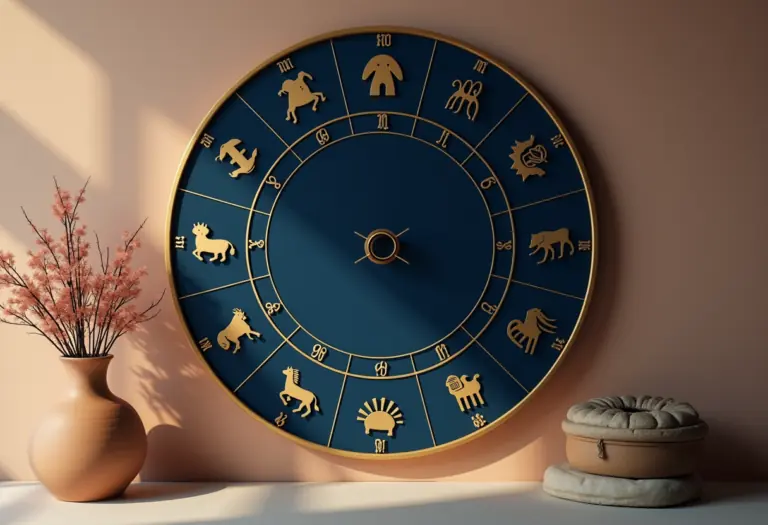
Chinese Zodiac Animal Years: The Twelve and Their Elements

The short answer
The Chinese zodiac animal years run in a fixed twelve-year order: Rat, Ox, Tiger, Rabbit, Dragon, Snake, Horse, Goat, Monkey, Rooster, Dog and Pig. Each year also carries one of five elements, so a given animal and element pair recurs every sixty years. The animal year begins at Chinese New Year or in early February, not on January 1.
The twelve animals with their years, the sixty-year element cycle underneath them, and why the animal is closer to a generational marker than a sun sign.
Chinese Zodiac Animal Years: The Twelve and Their Elements
The twelve animals of the Chinese zodiac run in a fixed order, one per year, and
repeat every twelve years. That much is widely known. What is less often explained
is the second cycle running underneath — five elements that shift the combination so
that a given animal and element pairing comes round only once in sixty years.
Here are the animals and their years, how the longer cycle works, why the year
boundary is not January the first, and how the system compares with the Western
zodiac it is often assumed to mirror.
The twelve animals and their years
The sequence is Rat, Ox, Tiger, Rabbit, Dragon, Snake, Horse, Goat, Monkey,
Rooster, Dog and Pig. Some sources render the Goat as Sheep and the Pig as Boar;
these are translation choices rather than different animals.
| Animal | Recent years |
|---|---|
| Rat | 1972, 1984, 1996, 2008, 2020 |
| Ox | 1973, 1985, 1997, 2009, 2021 |
| Tiger | 1974, 1986, 1998, 2010, 2022 |
| Rabbit | 1975, 1987, 1999, 2011, 2023 |
| Dragon | 1976, 1988, 2000, 2012, 2024 |
| Snake | 1977, 1989, 2001, 2013, 2025 |
| Horse | 1978, 1990, 2002, 2014, 2026 |
| Goat | 1979, 1991, 2003, 2015, 2027 |
| Monkey | 1980, 1992, 2004, 2016, 2028 |
| Rooster | 1981, 1993, 2005, 2017, 2029 |
| Dog | 1982, 1994, 2006, 2018, 2030 |
| Pig | 1983, 1995, 2007, 2019, 2031 |
Each year in the table covers most but not all of that calendar year, for the
reason in the next section. Anyone born in January or the first days of February
should check the boundary before taking a row at face value.
The year does not start on the first of January
Two conventions are in use, and they disagree by a few weeks.
The first starts the animal year at Chinese New Year, a lunisolar date that falls
somewhere between late January and late February. The second starts it at
Lichun, the solar term marking the beginning of spring, which lands around
the fourth of February each year.
For a birth in early January the previous year’s animal applies under both
conventions. For a birth between late January and mid February the two can give
different answers, and neither is wrong — one reckoning is lunisolar and the other
solar. The four-pillars tradition generally uses the solar one. Whichever your
source applies, it should say so, and if it does not that is worth knowing before
you build anything on the result.
The five elements and the sixty-year cycle
Each year also carries one of five elements: wood, fire, earth, metal and water.
The element advances every two years, and because five elements and twelve animals
have a lowest common multiple of sixty, a specific combination such as a Water Tiger
or a Wood Dragon recurs once every sixty years rather than every twelve.
The mechanism behind this is the sexagenary cycle, built from ten heavenly stems
and twelve earthly branches. The twelve branches are what the animals name. The ten
stems are the five elements in a yin and a yang form, which is why the element holds
for two years at a time. Pairing the two sequences and running them together
produces sixty distinct combinations before the pattern repeats.
Those five elements are not the four Western elements with
one added. They belong to a different framework with its own generating and
controlling relationships, and translating between the two schemes is a habit that
misrepresents both.
How this compares with the Western zodiac
The two systems are frequently described as equivalents, with the animal treated
as a Chinese version of a Sun sign. Structurally they are not alike at all.
| Chinese animal year | Western sun sign | |
|---|---|---|
| Unit of time | A year | About a month |
| What determines it | The year of birth | The Sun’s zodiac position at birth |
| How many people share it | Everyone born that year | Everyone born in that month-long span |
| Full cycle | Sixty years, with the elements | One year |
| Its place in the full system | One of four pillars, and the outer one | One factor among many in a birth chart |
The row worth pausing on is the third. An animal year is shared by everyone born
in the same year, which makes it much closer in kind to a generational marker than
to a personal one. The nearest Western analogue is not the
Sun sign but a slow outer-planet placement like the
Pluto in Scorpio generation — something that describes a
cohort rather than an individual.
That is also why traditional Chinese practice treats the year pillar as the outer
layer and reads the day pillar as the person. A reading built on the animal year
alone is working with the broadest of the four available strokes. The same logic
governs how the compatibility groupings should be held.
An animal year is not a spirit animal
This comes up often enough to be worth stating plainly. The Chinese zodiac animal
is a marker of position in a calendrical cycle. It is not a spirit animal, a totem
or a guide, and those concepts belong to entirely separate traditions — largely
Indigenous North American ones, where they carry specific cultural meanings that a
zodiac cycle does not.
Conflating the two misrepresents both. If you want to know your animal year, the
table above answers it; that is a different question from anything a spirit animal
framework is about.
What the animal year does and does not describe
Read as a symbolic frame, an animal year offers a set of associations you can hold
your own experience against. Held that way it is much like a
personal year number or any other cyclical marker:
interesting where it meets recognition, thin where it does not.
What it cannot do is predict, and it does not describe character with any
precision. A twelve-item cycle applied to a whole birth year gives roughly a twelfth
of the world the same label, which is a resolution too coarse to say much about a
person even before you notice that the tradition itself treats it as the outer
layer.
The honest use is the one that runs through all of this material: take the
description, hold it against something you already know about yourself or your year,
keep what lands and set down what does not. That is the register a
birth chart is best read in too, and it does not become
weaker for being modest about what it claims.
Frequently Asked Questions
What are the twelve Chinese zodiac animals in order?
Rat, Ox, Tiger, Rabbit, Dragon, Snake, Horse, Goat, Monkey, Rooster, Dog and Pig. The sequence repeats every twelve years. Some sources translate the Goat as Sheep and the Pig as Boar, which are rendering choices rather than different animals.
How do I find my Chinese zodiac animal?
Find your birth year in the twelve-year cycle — 2020 was a Rat year, 2024 a Dragon year, 2026 a Horse year, and the pattern repeats every twelve years in both directions. If you were born in January or the first part of February, check the year boundary, because the animal year does not begin on the first of January.
When does the Chinese zodiac year actually change?
There are two conventions. One begins the animal year at Chinese New Year, a lunisolar date falling between late January and late February. The other begins it at Lichun, the solar term for the start of spring, around the fourth of February. They can give different animals for births in that window, and the four-pillars tradition generally uses the solar reckoning.
What are the five elements in the Chinese zodiac?
Wood, fire, earth, metal and water. The element changes every two years, and because five elements and twelve animals combine into sixty pairings, a specific combination such as a Wood Dragon recurs once every sixty years rather than every twelve. The underlying structure is the sexagenary cycle of ten heavenly stems and twelve earthly branches.
Is a Chinese zodiac animal the same as a Western sun sign?
No. A sun sign comes from the Sun’s position at the moment of birth and covers about a month; an animal year covers a whole year and is shared by everyone born in it. That makes the animal much closer to a generational marker than a personal one, and the traditional system treats the year as the outer of four pillars rather than as the person.
Is my Chinese zodiac animal my spirit animal?
No. The zodiac animal marks a position in a calendrical cycle. Spirit animals and totems belong to separate traditions, largely Indigenous North American ones, where they carry specific cultural meanings unrelated to a twelve-year calendar. Treating the two as the same thing misrepresents both.
New readings and guides by email
The title, a short excerpt and a link for each new reading or guide on this site. At most two emails a month.