Juno in Libra: What This Placement Describes About Partnership

The short answer
Juno in Libra places the asteroid of committed partnership, read as the terms a person expects a partnership to run on, in the sign of the scales. It is associated with a partnership instinct built on symmetry: matched effort, negotiated terms and an arrangement that feels fair to both sides. It describes an orientation, not an outcome.
A reflective reading of the partnership clause Juno describes when it falls in the sign of the scales, and of how house, aspect and Venus finish the sentence.
Juno in Libra: the partnership instinct read through the scales
Juno is one of the asteroids that entered astrological practice long after the seven traditional planets were settled, and it carries a narrower brief than any of them. Where Venus describes attraction and the Moon describes need, Juno is read as the part of the chart that concerns itself with the agreement — the terms a person consciously or unconsciously wants a committed partnership to run on. Placed in Libra, the sign named for a balance, that brief lands in the one place in the zodiac whose central symbol is a measuring instrument.
That doubling is the whole interest of the placement. Libra is already the relational sign, so Juno in Libra is not adding a relational theme to a chart that lacked one. It is intensifying a theme already present, and intensification tends to expose both the elegance and the strain of a pattern rather than smoothing it out.
What Juno describes in a birth chart
Juno takes its name from the Roman goddess of marriage, the consort figure whose mythology is preoccupied with fidelity, status within a union, and the enforcement of a contract. Astrologers who work with the asteroid read it accordingly: not as a description of whom a person will meet, but as a description of what the person believes a partnership is for. It points at expectations, at the unspoken clauses, and at the conditions under which someone feels the agreement is being honoured or broken.
This is a symbolic reading, not a mechanical one. Juno does not report on a relationship the way a thermometer reports on a room. It describes an orientation that the chart holder can recognise, argue with, or outgrow. Nothing in the placement determines an outcome, and any reading that treats it as a forecast has left interpretation behind.
What Libra brings to the placement
Libra is cardinal air, ruled by Venus, and it sits opposite Aries on the axis that runs between self and other. Cardinal means it initiates; air means it works through comparison, language and idea; Venus rulership means it evaluates by proportion and taste. If the modality of a sign tells you how a placement moves, Libra’s cardinality is worth holding on to here, because the sign is often mistaken for a passive one. Libra initiates — it just initiates toward someone rather than away.
The scales themselves are the clue most often flattened into a cliche. A balance does not produce fairness. It displays a comparison, and it is only useful while both pans are still moving. Juno in Libra tends to describe someone for whom a partnership is a live comparison rather than a settled state: the terms are always being weighed, adjusted and weighed again.
The recurring themes of Juno in Libra
Fairness as the governing clause
The clause this placement most often writes into its private contract is symmetry. Effort should be matched, concessions should be reciprocal, and a lopsided arrangement registers as a breach even when nothing was explicitly agreed. This is a real strength in a partnership that can bear the scrutiny, and it is the source of the placement’s most familiar difficulty, because reciprocity that is measured too finely stops being generosity and becomes accounting.
The partner as mirror
Libra thinks by comparison, so Juno here often describes someone who understands themselves most clearly in the presence of another person. The relationship becomes an instrument of self-knowledge, which is genuinely productive and also carries an obvious cost: an instrument you depend on is hard to put down. This is the theme the Descendant already covers in every chart, and a Libra Juno usually amplifies whatever that angle is saying rather than contradicting it.
Peace held at a price
The strain that shows up most often is conflict avoidance mistaken for harmony. Libra’s instinct is to keep the pans level, and the fastest way to level a balance is to stop adding weight to either side — which is to say, to stop raising the thing that would tip it. Read reflectively, this placement asks whether the quiet in a partnership is agreement or postponement. It does not answer the question; it is the question.
Juno in Libra compared with the other cardinal signs
Placing Juno across the cardinal signs is the clearest way to see what Libra is actually contributing, because all four initiate and only the direction differs.
| Juno placement | What the agreement is built around | Where the pattern strains |
|---|---|---|
| Juno in Aries | Autonomy inside the union; a partner who does not dilute the self | Independence defended past the point where it excludes intimacy |
| Juno in Cancer | Belonging, shelter, continuity of care over time | Loyalty that quietly becomes obligation |
| Juno in Libra | Symmetry, negotiated terms, a partnership that reads as fair from both sides | Fairness measured so finely that it replaces warmth; conflict deferred to keep the balance level |
| Juno in Capricorn | Structure, durability, a commitment with visible shape | Form maintained after the substance has changed |
House and aspect: what actually finishes the reading
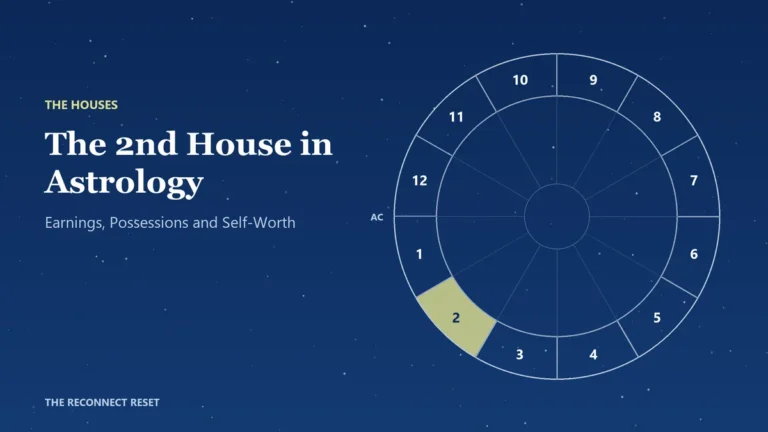
A sign on its own is an unfinished sentence. The house Juno occupies shows the arena where the theme becomes visible, and it can shift the placement’s texture considerably. Juno in Libra in the seventh house is the theme sitting in its own natural territory, close to the surface of the chart holder’s relational life. In the ninth house the same Libra clause tends to be phrased in terms of shared outlook — a partnership whose fairness is a fairness of belief, meaning, travel or study, where being intellectually met matters as much as being practically matched. In the second or eighth, the language of the contract borrows the vocabulary of resources, which is where the older phrase material marriage comes from: a reading in which the terms of the union are discussed in tangible things. That is a description of emphasis, not a prediction of wealth, and it should never be read as one.
Aspects then modify the tone. Contacts from Saturn tend to formalise the clause and slow its expression; contacts from Uranus tend to argue with it; contacts from Neptune blur the terms the placement is otherwise so keen to specify. If aspect language is still unfamiliar, the geometry behind those contacts is worth learning before the asteroid detail, because the aspects change the reading more than the asteroid does.
One further step is easy to skip. Libra is ruled by Venus, so Juno in Libra is dispositted by Venus — the condition of Venus in that same chart colours everything Juno is saying. A Venus in a difficult sign or under heavy tension does not cancel the Libra Juno; it describes the conditions under which that partnership instinct has to operate.
Juno in Libra between two charts
The placement becomes more interesting when a second chart enters the picture, because expectations are only tested against someone. In synastry, contacts to a Libra Juno from another person’s Venus, Sun, Moon or angles are read as places where that person meets or misses the clause the placement cares about. A composite chart asks a different question again — not what either person wants, but what the relationship as a third thing appears to be organised around.
Neither technique produces a verdict on compatibility, and the honest use of both is diagnostic rather than predictive: they describe where friction is likely to be discussed, not whether a relationship succeeds.
Where the symbol stops
Juno is a small body carrying a very old story, and the story is doing most of the work in any interpretation. That is not a reason to discard it, but it is a reason to hold it lightly. A Libra Juno is a useful lens for noticing how you negotiate, what you consider fair, and how quickly you smooth a disagreement over. It is not a statement about whether a partnership lasts, whom you should choose, or what you owe anyone. If a reading of this placement starts producing instructions, it has stopped interpreting and started prescribing — and the placement itself, being Libra, would probably want both sides of that argued out first.
Frequently Asked Questions
What does Juno in Libra mean in a birth chart?
Juno is read as the part of the chart concerned with the terms of a committed partnership — the unspoken clauses a person expects an agreement to run on. In Libra it describes a partnership instinct organised around symmetry: matched effort, negotiated terms, and an arrangement that reads as fair from both sides. It describes an orientation, not an outcome.
Is Juno in Libra a good placement?
Astrology has technical dignities for the seven traditional planets, but no comparable scoring system for the asteroids, so calling a Juno placement good or bad imports a judgement the technique does not actually make. Libra is Juno’s most thematically doubled sign rather than its strongest one — the relational emphasis is intensified, which sharpens both the elegance of the pattern and its characteristic strain.
What does Juno in Libra in the 9th house add?
The ninth house concerns outlook, meaning, belief, study and distance from the familiar. A Libra Juno there tends to phrase its fairness clause in those terms: being intellectually and philosophically met matters as much as being practically matched, and shared perspective becomes part of what the agreement is understood to cover. The house shows the arena, the sign shows the terms.
Where does the phrase “material marriage” come from in Juno readings?
It appears when Juno sits in a house or sign whose vocabulary is tangible — resources, possessions, shared assets — and the terms of the union get discussed in those concrete terms. It is a description of emphasis, of what the contract talks about, and it is not a claim about wealth, security or any financial result. Read it as language, not as forecast.
Does Juno in Libra say anything about who someone will marry?
No. Juno describes what a person appears to want an agreement to be, which is information about them rather than about anyone else. Contacts between two charts in synastry can show where one person’s placements meet or miss that clause, but that is a map of likely friction points, not an identification of a partner or a prediction that a relationship will form or last.
Do I need to know Juno to read a birth chart?
Not at the start. The planets, signs, houses and aspects carry most of the interpretive weight, and the asteroids are a refinement layered on top of a reading that already works without them. Learning Venus, the seventh house and the Descendant first will tell you more about relational themes than Juno will — the asteroid adds nuance to that picture rather than replacing it.
How do I find my Juno sign?
Juno is calculated from a birth date, exact birth time and birthplace in the same way any chart factor is, and most chart calculators include the four major asteroids as an option that has to be switched on. The sign is stable across a whole day, so an approximate birth time still gives a reliable Juno sign, though the house placement needs an accurate time to be meaningful.
New readings and guides by email
The title, a short excerpt and a link for each new reading or guide on this site. At most two emails a month.