Synastry Chart: What It Reveals About Compatibility
The short answer
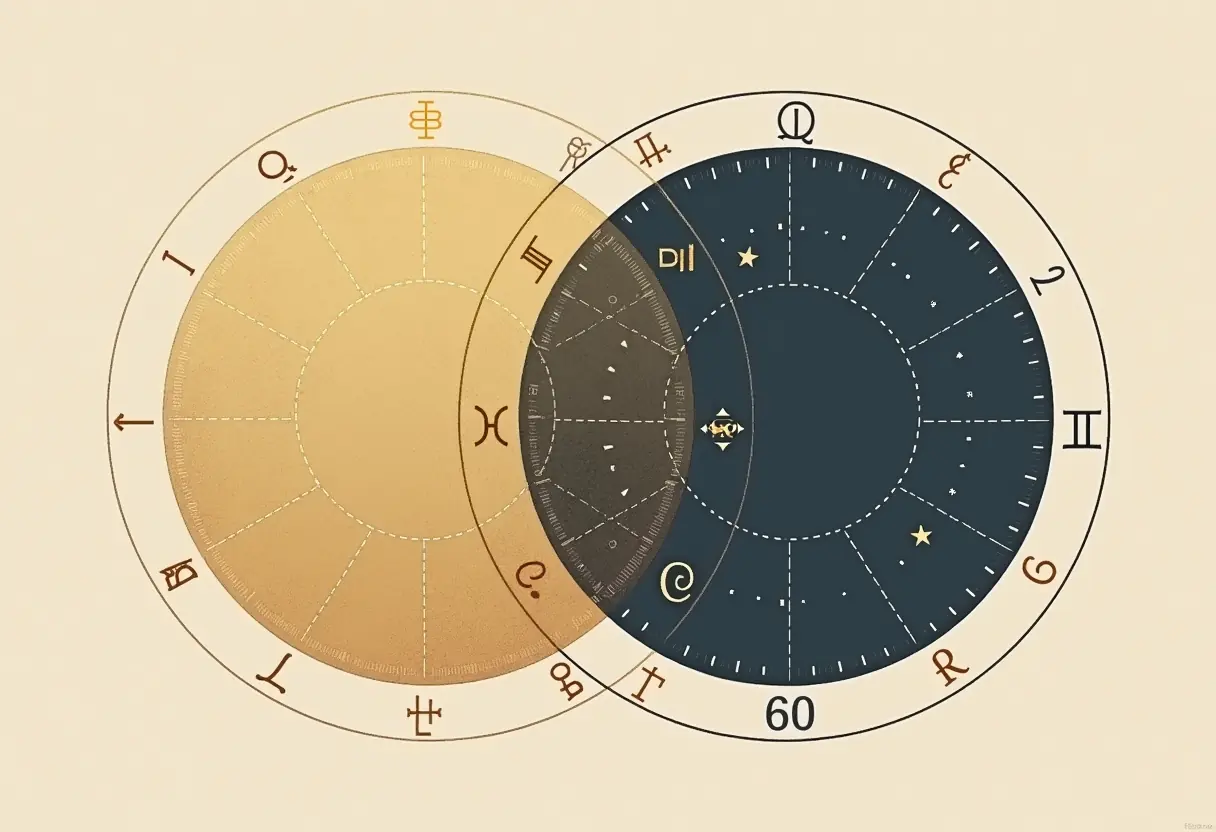
A synastry chart lays two people's birth charts side by side to see how they interact: the aspects one person's planets form to the other's, and which of the other person's houses each planet falls in. It is traditionally read as a lens on where a relationship flows easily and where it takes work, not as a verdict on whether it lasts.
A synastry chart takes two people’s birth charts and lays them side by side to see how the placements interact – whose planets land in whose houses, and which angles form between them. It is the branch of astrology most people reach for when they want to understand a relationship: romantic, but just as often a friendship, a sibling, or a business partner.
Read as intended, a synastry chart is a lens, not a verdict. It points to places where two people are likely to move easily together and places where they will have to work at understanding each other – it does not predict whether the relationship lasts, and it is not a substitute for how two people actually treat each other.
How a Synastry Reading Actually Works
A synastry reading starts with two ordinary birth charts, the same kind used for an individual reading, then combines them in two ways. The first is the angles, or aspects, formed between one person’s planets and the other’s – if your Venus sits close to their Mars, that angle is read on its own, independent of anything else in either chart. The second is the house overlay: taking your planets and seeing which of the other person’s twelve houses they fall into, which shows which parts of that person’s life your presence tends to touch.
Most readings focus on a handful of pairings rather than trying to compare every planet to every other planet, since not every combination carries equal weight in the tradition.
The Aspects Between Two Charts
An aspect is simply the angular distance between two points, measured in degrees. In synastry, the same handful of aspects used in a single chart are read between two charts instead:
| Aspect | Approx. angle | How it is traditionally read |
|---|---|---|
| Conjunction | 0° | The two planets’ energies blend closely – intense, whether the pairing is an easy one or a difficult one |
| Sextile | 60° | An easy, cooperative angle – support that takes a little effort to use, not automatic |
| Square | 90° | Friction that tends to prompt growth – the pairing that most often surfaces real disagreement |
| Trine | 120° | The most naturally flowing angle – comfortable, sometimes to the point of taking each other for granted |
| Opposition | 180° | Pulling in different directions – can mean real tension, or a balance each person completes for the other |
A single square or opposition between two charts is not a warning sign on its own. Most long, workable relationships have several of each – what tends to matter more is the overall mix, and how much either person is willing to meet the friction rather than resent it.
Which Planets Carry the Most Weight
Every planet in one chart can theoretically touch every planet in the other, but a few pairings do most of the work in a traditional reading:
- Sun to Moon – one person’s core identity meeting the other’s emotional instincts; often read as the backbone of long-term ease between two people
- Venus to Mars – the classic attraction pairing, one person’s sense of affection meeting the other’s drive and desire
- Moon to Moon – whether the two people process feelings in a similar rhythm or a very different one
- Ascendant contacts – a planet landing near the other person’s rising sign often shows up as an immediate, first-impression pull
- Saturn to personal planets – traditionally read as a steadying, sometimes heavy influence – the pairing associated with commitment and staying power rather than spark
A Few More Pairings Worth Knowing
Beyond that core handful, a few other combinations come up often enough in the tradition to be worth naming. Mars to Mars is read as a match of pace and drive – two people who move through the world at a similar speed, or two people who each want to lead and have to negotiate that. Sun to Jupiter is traditionally one of the more generous contacts, associated with one person encouraging the other’s confidence and sense of possibility. Moon to Venus touches on affection and comfort together, often read as warmth that feels easy rather than effortful.
Sun to Saturn deserves a specific note, because it is one of the aspects people worry about most and one of the most misread. In the tradition it is not read as a curse on the relationship – it is closer to a weight, the sense of being tested or held to account by the other person. Many long, stable partnerships have this contact somewhere in the mix; the same aspect that can feel restrictive early on is often the one that ages into reliability.
Reading an Aspect in Context, Not in Isolation
The same synastry aspect can land very differently depending on what is already present in each person’s own chart. A partner’s Saturn landing on your Moon reads differently if your own chart already has a natal Saturn-Moon aspect – in that case, it is echoing something already familiar rather than introducing something new. The same contact landing on a Moon that has never had to deal with Saturn’s weight before can feel far more unfamiliar and heavier by comparison.
This is one reason a synastry chart is read alongside both individual charts, not as a standalone document. A single aspect in isolation is a data point; the same aspect read against what each person already carries is closer to the actual picture.
House Overlays: Where Their Planets Land in Your Life
The second half of a synastry reading is the house overlay: taking one person’s planets and dropping them into the other person’s twelve houses. Where they land is traditionally read as which area of that person’s life the relationship activates.
A partner’s Venus falling in your seventh house – the house long associated with partnership – is a straightforward emphasis on that person as a relationship. The same planet falling in your tenth house instead points toward how the relationship touches your public life and ambitions rather than your private one. An eighth-house overlay is traditionally associated with intimacy and shared resources; a fifth-house one, with romance, play, and creative expression.
House overlays go in both directions – your planets fall somewhere in their chart too, and a full reading looks at both sides rather than just one.
What a Synastry Chart Does Not Tell You
It is easy to treat a synastry chart like a compatibility score, and that is the one habit worth resisting. A chart with mostly easy aspects can still describe two people who never challenge each other to grow; a chart full of hard angles can describe two people who work hard at understanding one another and build something durable because of it, not despite it.
A synastry reading is best used as a starting point for a conversation two people have with each other, not a substitute for it. It can name a pattern worth noticing – a recurring friction point, a natural strength – but what either person does with that information is still entirely up to them.
Getting Your Own Synastry Reading
A synastry comparison needs the same information a single birth chart does, for both people:
- Full birth date for each person
- Birth time, as exact as either of you can find – a birth certificate or hospital record is more reliable than family memory
- Birth location (city is generally enough)
Without an exact birth time, the Sun, Moon, Venus, and Mars placements – and the aspects between them – are still readable. What becomes unreliable without a time is the ascendant and the house overlay, since both shift throughout the day. If one person’s birth time is uncertain, it is worth saying so plainly in the reading rather than treating the house placements as settled fact.
A thorough reading usually walks through the aspects in rough order of weight – Sun, Moon and the personal planets first, then the house overlays, then the slower-moving planets like Saturn and Jupiter last, since those tend to describe the relationship’s texture over years rather than its day-to-day feel. Treat the whole thing as a map of tendencies worth watching for, not a set of instructions to follow.
Frequently Asked Questions
Is a synastry chart only for romantic relationships?
No. The same overlay method is used for friendships, family relationships and business partnerships – the aspects and house placements are read the same way, only the context around them changes.
Does a difficult synastry aspect mean a relationship will fail?
Not on its own. Squares and oppositions are traditionally read as friction that prompts growth, not as a warning to avoid the relationship – most long relationships have several of them alongside easier aspects.
Can I get a synastry reading without an exact birth time?
Partially. The Sun, Moon, Venus and Mars placements and the aspects between two charts are still readable without a birth time. The ascendant and house overlays need an accurate time, since both change throughout the day.
What is the difference between synastry and a composite chart?
Synastry compares two separate birth charts side by side and looks at the aspects and overlays between them. A composite chart is a different technique – it mathematically blends the two charts into one new chart meant to represent the relationship itself, rather than comparing the two individuals.
New readings and guides by email
The title, a short excerpt and a link for each new reading or guide on this site. At most two emails a month.