The North Node in Astrology: Your Chart’s Direction of Travel
The short answer
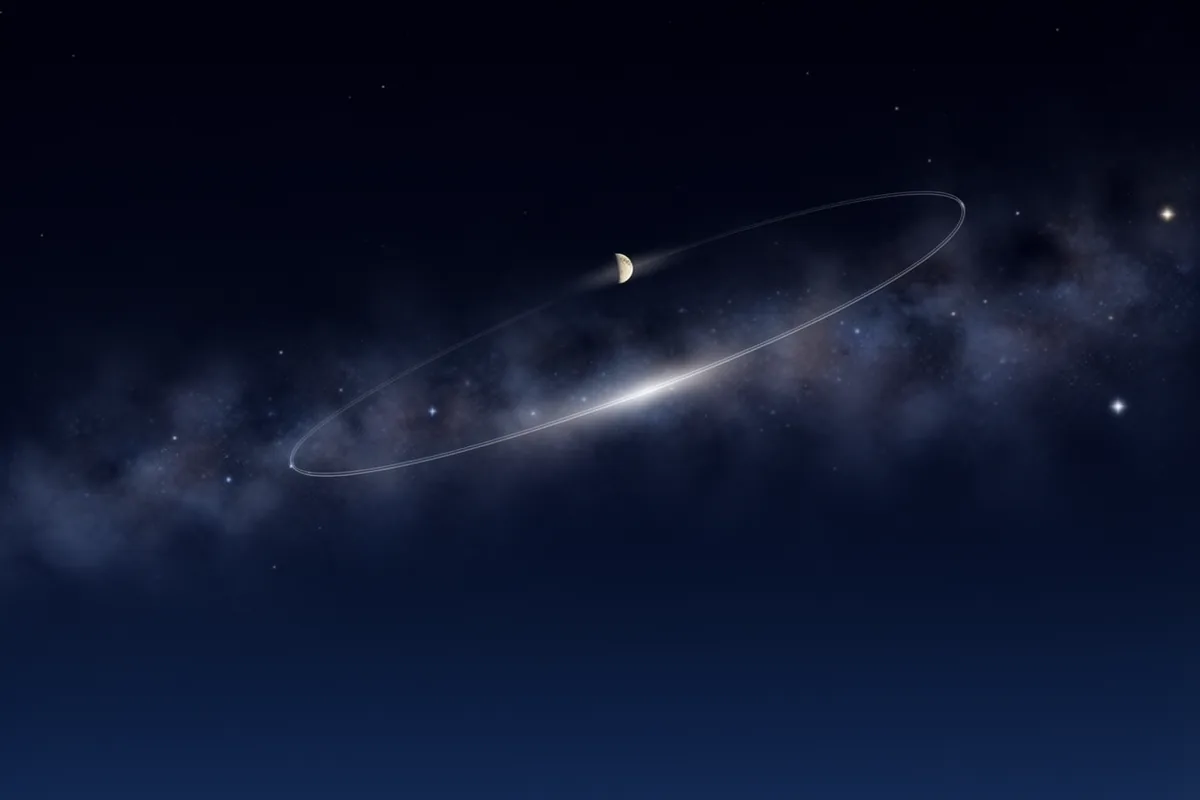
In astrology, the North Node is one end of the lunar nodal axis, a point where the Moon's orbit crosses the plane of Earth's orbit, not a planet. Its meaning is traditionally read as the unfamiliar end of the axis: the direction of development that does not come easily, opposite the comfortable South Node. Its house shows where in life that pull appears.
Key facts
- The lunar nodes are where the Moon’s orbit crosses the ecliptic; the North (ascending) Node is where it crosses from south to north. (Source: NASA Eclipse Web Site, checked )
- The Moon’s orbit is inclined about 5° (mean 5.145°) to the plane of Earth’s orbit around the Sun. (Source: NASA Eclipse Web Site, checked )
- The lunar nodes move retrograde along the ecliptic and complete one circuit in 18.6 years. (Source: NASA Eclipse Web Site, checked )
- With an 18.6-year cycle, the nodes return to their birth position at roughly ages 18–19, 37, 56 and 74. (Source: NASA Eclipse Web Site, checked )
Most of a birth chart describes what you already are. The lunar nodes describe a tension — one thing that comes easily and one that does not, sitting exactly opposite each other. The North Node is the half that does not come easily, which is why it gets written about as direction, purpose or growth edge.
Here is what the North Node actually is, how to find yours, and what the symbol is doing in a chart once you have it.
The nodes are not planets
This is the part most introductions skip, and it explains everything else.
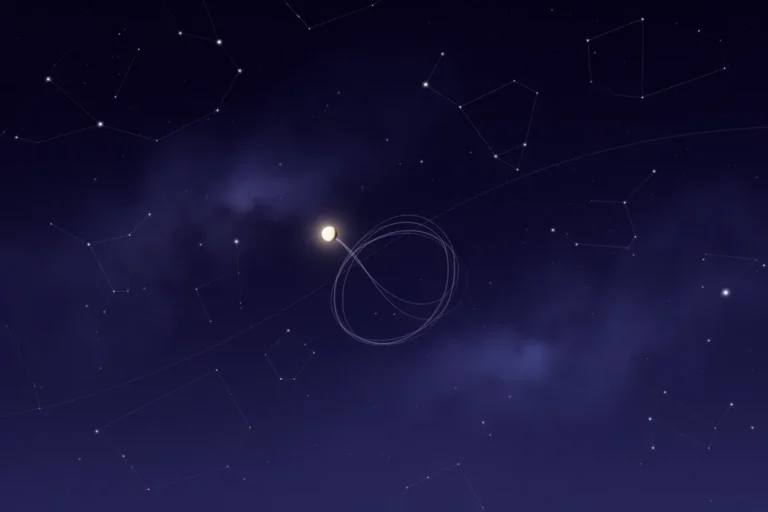
The Moon’s orbit is tilted a little over five degrees relative to the plane of Earth’s orbit around the Sun. Those two planes intersect along a line, and the two points where the Moon crosses that line are the lunar nodes. The North Node is where the Moon crosses going north; the South Node is the point directly opposite.
Three consequences follow, and they are the whole reason the nodes are read the way they are:
- They are always exactly opposite. 180 degrees apart, always. You cannot have one without the other, which is why the nodes are read as a pair rather than as a single placement.
- They move backwards. The nodal axis drifts retrograde through the zodiac, against the order of the signs. This one is a real motion, unlike Mercury retrograde, which is an effect of perspective rather than anything the planet does.
- The cycle is about 18.6 years, so the nodes spend roughly eighteen months in each sign. Everyone born within that window shares a nodal sign — which tells you immediately that the sign alone is a generational marker, not a personal one.
That last point matters. If your North Node sign describes you and several million contemporaries equally, the personal detail has to come from somewhere else: the house it falls in, and what it touches in the rest of your chart.
Finding yours
You need a birth chart calculated from date, exact time and place. Date alone gives you the nodal sign — enough for the generational reading. The free calculator on the nodal return page shows it: enter a birth date and it gives the sign and degree of your natal North Node by both the mean and the true node. The birth time is what places the nodes in houses, and the house is where the reading becomes personal.
If you have not calculated a chart before, the same birth data drives every other placement worth knowing: start with how to find your rising sign, which is the placement most dependent on an accurate birth time, and your moon sign.
One technical note that causes confusion: charts list either a True Node or a Mean Node. The Mean Node is a smoothed average of the nodal motion; the True Node is the actual position, which wobbles and occasionally appears to move forward briefly. They differ by at most a degree or two. Unless your node sits within a degree of a sign boundary, the distinction changes nothing about the interpretation.
The same wobble explains the “Rx” some charts print beside the node. The Mean Node always moves backwards through the zodiac, and the True Node does too about three-quarters of the time, turning direct for short spells a couple of times a month. A retrograde North Node is therefore the ordinary state rather than a special placement, and most astrologers do not read it the way they read a retrograde planet.
What the axis is read as
The South Node is the familiar end — the mode you fall back into under stress, the competence that arrives without effort. Not a flaw. Its problem is that it is comfortable, so it is where you go to avoid difficulty.
The North Node is the unfamiliar end. It tends to feel effortful, slightly unnatural, sometimes faintly embarrassing to attempt. Astrologically it is read as the direction of development — not because the South Node qualities are bad, but because a life lived entirely at one end of an axis is a life running on one setting.
The reading is never “abandon the South Node.” The axis is a pair. What is described is a shift in weight — bringing South Node capability with you rather than living inside it.
Read the house before the sign
Because everyone born in an eighteen-month window shares the nodal sign, the house is what makes the placement yours. The house says where in life the pull shows up: a North Node in the tenth house locates it in vocation and public standing; in the fourth, in home, family and private life; in the seventh, in one-to-one relationship.
And since the axis is an opposition, the South Node always sits in the opposite house — tenth and fourth, first and seventh, third and ninth. The pair describes a see-saw between two areas of life, not a single spot on the map.
When the nodes get loud
Because the cycle runs about 18.6 years, the transiting nodes return to their birth position at roughly 18–19, 37, 56 and 74 — and reach the exact opposite point at roughly half those intervals. Practitioners watch those windows the way they watch the Saturn cycle: as a period when the theme of the axis stops being abstract.
The nodal return sits close enough to other well-known transits that they are easy to confuse. If you are in your late twenties or mid-fifties and trying to work out which cycle you are in, Saturn Return: what it means and how to work with it covers the other one. For a year-by-year layer that is easier to track, there is the personal year number, and for the numerological equivalent of a direction-of-travel reading, how to calculate your life path number.
Three things the North Node is not
- Not a prediction. It does not say what will happen or when. It describes a tension present from birth.
- Not a job title. “North Node in the tenth house” is not a career recommendation. Houses describe areas of life, not occupations.
- Not a verdict on the South Node. The skills at that end are real skills. The reading is about weight, not rejection.
Used well, the nodal axis is the most useful thing in a chart for a straightforward reason: it points at the part of your own life you are most likely to be avoiding, and it names what you are avoiding it with.
Astrology is offered here for reflection and entertainment. It is not a substitute for medical, psychological, legal or financial advice.
New readings and guides by email
The title, a short excerpt and a link for each new reading or guide on this site. At most two emails a month.