The 1st House in Astrology: Rising Sign, Body and First Impressions
The short answer
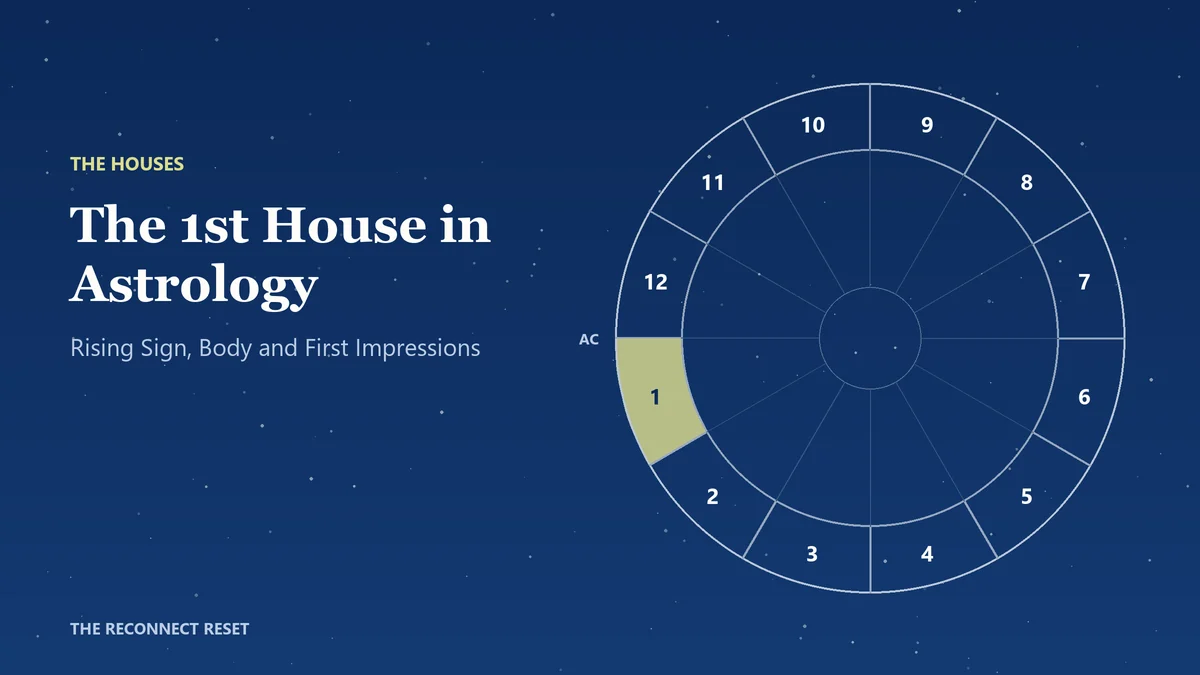
In 1st house astrology, the first house describes the self: your body, appearance, temperament and the way you meet the world before anyone knows you. Its cusp is the Ascendant, so the rising sign colors it, and that sign's ruler, the chart ruler, shows where your energy tends to go.
This is a reference page for reading the first house in your own chart or anyone else's. It covers what the house governs, how the rising sign and chart ruler work, what each group of planets tends to describe there, and what an empty 1st house means.
What 1st House Astrology Covers
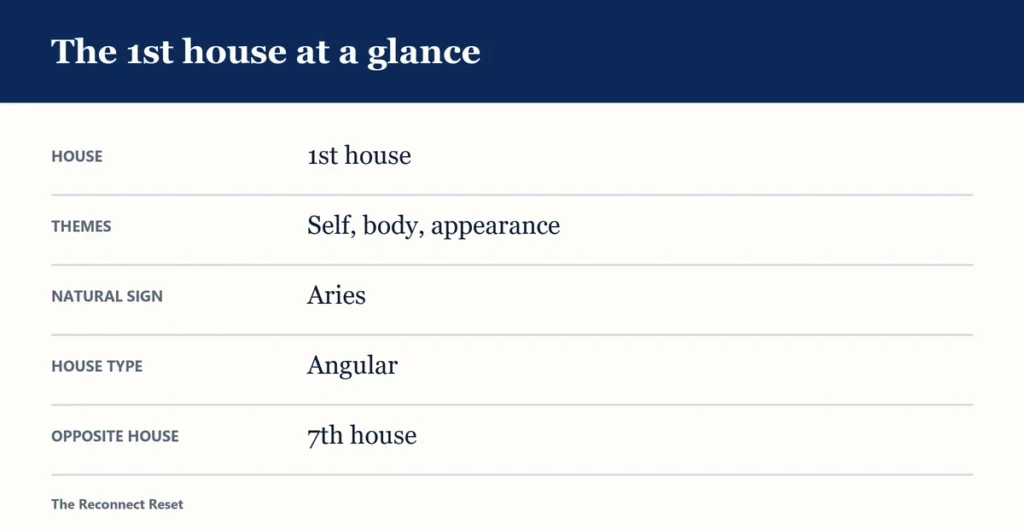
The first house is the house of the self in the most literal sense. Traditional astrology gave it the body, physical appearance, vitality and general temperament, and modern astrology adds the persona: the manner, pace and style you show when you walk into a room. It describes how you approach life before anyone has asked you to.
It is one of the four angular houses, along with the 4th, 7th and 10th, and angular houses are read as the most visible and active parts of a chart. Planets here show up in posture, in the first sentence out of your mouth and in the reflex you have whenever something new starts.
Its natural sign is Aries and its natural ruler is Mars, which is why the house carries a flavor of initiative and beginnings even in charts where neither appears. Hellenistic astrologers gave Mercury its joy here, so a 1st house Mercury was considered especially at home. Across the chart sits the 7th house of partners: the 1st is you as you begin, the 7th is the person facing you.
Is Your Rising Sign Your First House?
Usually, yes, though the details depend on the house system. The rising sign is the zodiac sign coming up over the eastern horizon at the moment and place of your birth, and the exact degree on that horizon is the Ascendant. Every common house system starts the 1st house there, which is why the two terms get used almost as synonyms.
In whole-sign houses, the entire rising sign is the 1st house, from 0 to 30 degrees, and the next sign is the 2nd. In quadrant systems such as Placidus, the 1st house starts at the Ascendant degree and runs a variable distance, often into the next sign. With 25 degrees of Gemini rising, a planet in early Cancer may sit in the 1st house under Placidus but in the 2nd under whole signs.
These are different measuring conventions, not right and wrong answers. If a planet switches houses when you change systems, read it as bridging both topics, and give extra weight to anything within a few degrees of the Ascendant itself. An accurate birth time matters here, because the rising sign changes on average about every two hours.
The Sign on the Cusp and the Chart Ruler
The sign on the 1st house cusp sets the tone of your approach, and its ruling planet becomes the chart ruler, often considered the most important planet in the chart. With Leo rising the Sun is chart ruler; with Scorpio rising it is Mars traditionally and Pluto in modern practice. The house where the chart ruler sits shows where the self tends to direct its effort.
Sagittarius rising with Jupiter in the 10th, for example, reads as an open, questing manner channeled into career. Cancer rising with the Moon in the 4th turns the same protective style back toward home. The table below lists each rising sign, its ruler and the approach it is usually associated with.
Rising sign on the 1st house cusp, its ruler and its approach
| Rising sign | Chart ruler | Typical first approach |
|---|---|---|
| Aries | Mars | Direct, quick to start, competitive |
| Taurus | Venus | Steady, unhurried, attentive to comfort |
| Gemini | Mercury | Curious, talkative, adaptable |
| Cancer | Moon | Protective, reads the mood first |
| Leo | Sun | Warm, visible, generous with attention |
| Virgo | Mercury | Observant, modest, precise |
| Libra | Venus | Courteous, diplomatic, aware of others |
| Scorpio | Mars / Pluto | Reserved, intense, watchful |
| Sagittarius | Jupiter | Open, frank, restless for more |
| Capricorn | Saturn | Composed, serious, self-contained |
| Aquarius | Saturn / Uranus | Independent, friendly but detached |
| Pisces | Jupiter / Neptune | Gentle, receptive, hard to pin down |
Planets in the 1st House, Group by Group
Any planet in the first house becomes part of your visible personality. It colors how you move and react, and other people tend to notice it quickly. The closer it sits to the Ascendant, the stronger that effect is traditionally read to be.
Sign matters as much as planet. Mars in the 1st in Libra behaves very differently from Mars in the 1st in Aries, so read the planet, its sign and its aspects together before settling on a meaning.
- Sun or Moon — a 1st house Sun puts identity on display and describes a recognizable presence; a 1st house Moon wears its moods openly and reacts to surroundings fast.
- Mercury, Venus or Mars — Mercury reads as a quick, verbal manner, Venus as charm and attention to style, Mars as directness, drive and some impatience.
- Jupiter or Saturn — Jupiter is associated with an expansive, optimistic bearing; Saturn with reserve, self-discipline and a seriousness that often eases with age.
- Uranus, Neptune or Pluto — Uranus suggests an unconventional streak people spot at once, Neptune an impressionable, dreamy quality, Pluto an intensity felt before a word is said.
- Nodes, Chiron or Lilith — the North Node here points to growth through self-direction, Chiron to tenderness around identity, Black Moon Lilith to a presence that refuses to shrink.
A 1st House Stellium, and an Empty 1st House
A stellium is three or more planets gathered in one house or sign, and in the 1st it concentrates much of the chart into personal presence. This is usually read as a self-starting, hard-to-overlook personality whose main lesson is that other people's agendas exist too. For more on how clusters are weighed, see what a stellium means in astrology.
An empty 1st house is common and says nothing about a weak sense of self. With only ten planets spread across twelve houses, most charts have several empty ones. When the 1st holds no planets, read it through the rising sign, any aspects to the Ascendant and, above all, the house and condition of the chart ruler.
The 1st House in Synastry and Profection Years
In synastry, another person's planets in your first house are traditionally read as that person noticing you quickly and affecting how you see yourself. Their Venus there often feels like admiration of your looks or style; their Saturn can feel like scrutiny or like steadiness, depending on the rest of the comparison.
Annual profections, a Hellenistic timing technique, move one house forward for each year of life, starting from the 1st house at birth. That makes ages 0, 12, 24, 36, 48, 60, 72 and 84 your 1st house profection years. They are traditionally read as years that put self, body and personal direction in focus, with the chart ruler serving as lord of the year.
Like every house, the first is a lens for reflection rather than a forecast. It asks how you show up and whether that matches who you are, and the rest of how to read a birth chart builds outward from that question.
Keep reading
Frequently asked questions
Which planet rules the 1st house in astrology?
Mars is the natural ruler of the 1st house because Aries is the first sign of the zodiac. In an individual chart, though, the ruler of the 1st house is the planet that rules the rising sign: Venus for Libra rising, Saturn for Capricorn rising, and so on. That planet, the chart ruler, shapes how the whole house is read.
Does the 1st house describe your appearance?
Traditionally, yes. The first house covers the body and physical presence, so the rising sign and any planet near the Ascendant are linked to style, posture, build and the impression you make. Family, culture and personal choice shape looks far more than any chart, so astrologers read these as tendencies in manner and self-presentation rather than a physical description.
What does it mean when someone's planets fall in your 1st house?
In synastry, a partner's or friend's planets in your 1st house describe how they react to your presence and how you feel seen by them. Their Mars there can feel energizing or pushy, their Jupiter encouraging. These overlays are usually noticed early in a connection, because the 1st house is about immediate, physical first impressions.
Is a 1st house stellium good or bad?
Neither. Three or more planets in the 1st house concentrate the chart around personal identity, which is usually read as strong self-direction, visible energy and a need to act on your own terms. The growth edge is balance with the 7th house: noticing other people's needs and letting partnership shape decisions instead of resenting it as an interruption.
New readings and guides by email
The title, a short excerpt and a link for each new reading or guide on this site. At most two emails a month.