Mercury Retrograde: What It Is and What It Is Not
The short answer
Mercury retrograde is the stretch, three or four times a year for about three weeks, when Mercury appears from Earth to move backward; no planet actually reverses. Its meaning comes from Mercury's role as messenger: it is traditionally read as a time to slow down on communication, contracts, travel plans and paperwork, and to read the fine print.
No planet in the solar system reverses direction. Mercury included. And yet three or four times a year the internet decides that contracts, laptops and conversations have become unreliable — because of a motion that is not actually happening.
Both halves of that are worth taking seriously: the astronomy, which is genuinely interesting, and the symbolism, which is what astrology is actually working with. Here is what Mercury retrograde is, when it falls in 2026, what it is realistically read as, and what it is not.
The astronomy: an apparent motion
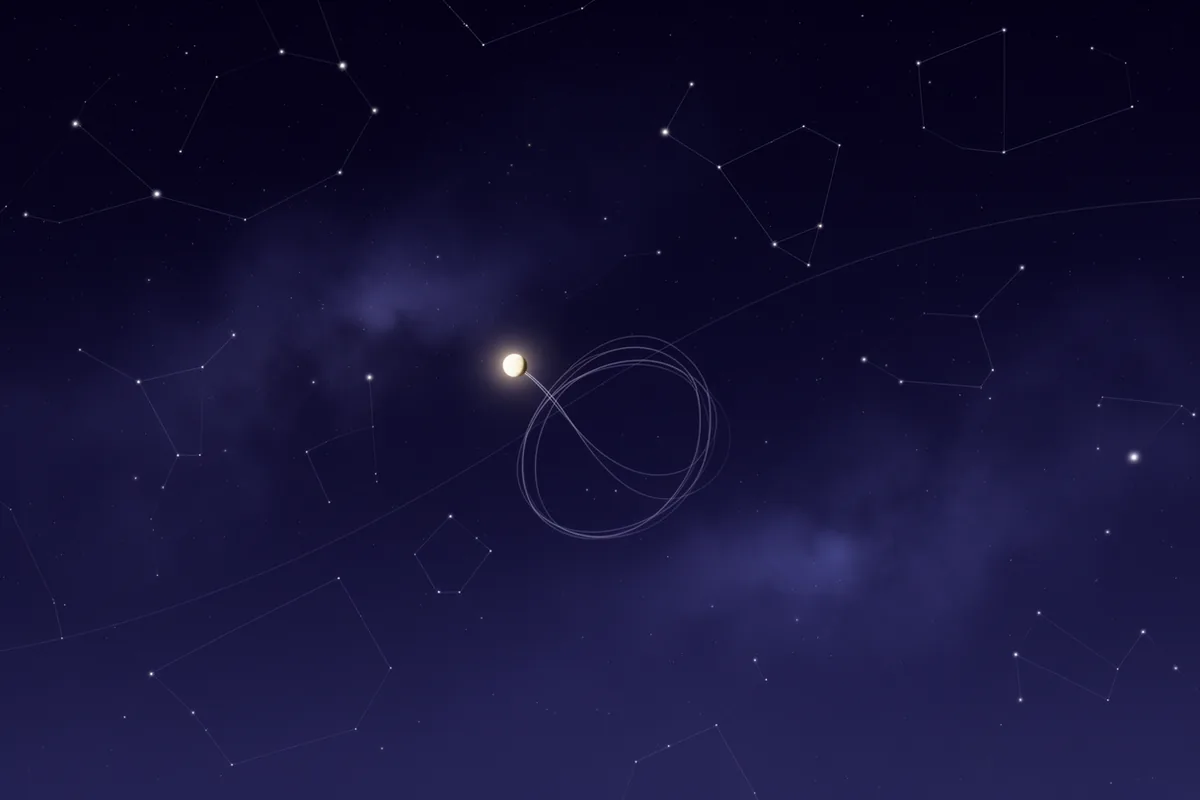
Retrograde motion is an effect of perspective, not a change in direction. Mercury orbits the Sun faster than Earth does and on a tighter path. Several times a year it overtakes Earth on the inside lane — and during that overtaking, seen against the fixed background of the stars, it appears to slow, stop, and drift backwards for a few weeks before resuming its normal apparent path.
The everyday analogy is a car overtaking a slower one on a motorway. As you pass it, it seems to slide backwards relative to the landscape behind it. Neither car reversed; only the relative position changed.
Two consequences follow:
- It happens three or four times a year, for roughly three weeks each time. This is the most frequent retrograde of any planet, which is a large part of why it dominates popular astrology — there is simply more of it to talk about.
- The stations matter more than the middle. Practitioners pay closest attention to the days when Mercury appears to stop before changing apparent direction — the stations — rather than to the calmer middle of the period.
There is also a wider window either side, commonly called the shadow or storm period, during which Mercury re-travels the same stretch of zodiac it will later cross again in retrograde. Astrologically this is treated as the run-up and the settling-down, and it is one reason the effects some people report do not line up neatly with the official start and end dates.
Where the reputation came from
The association is not arbitrary. In Roman mythology Mercury was the messenger of the gods and the patron of trade, travel and communication — the figure astrology later borrowed the planet’s name and symbolism from. That inherited role is why the retrograde period gets tied to letters, deals, journeys and gossip rather than to, say, romance or ambition, which fall under other planets. Understanding that the association is a symbolic inheritance rather than a claim about physics makes it easier to use the period as a lens rather than as a warning.
The 2026 retrograde calendar
Mercury turns retrograde three times in 2026. The dates below are cross-checked across several independent astrology and almanac sources that converge on the same windows.
| Window | Dates | Sign |
|---|---|---|
| First | February 26 – March 20, 2026 | Pisces |
| Second | June 29 – July 23, 2026 | Cancer |
| Third | October 24 – November 13, 2026 | Scorpio |
The third window is the next one from today’s date, so it is worth marking on a calendar rather than reacting to once it has already started. The sign each retrograde falls in matters for a personalised reading: which house of your own chart that sign occupies is what turns a general astronomical event into something specific to you, and that requires your rising sign, not just your sun sign.
Practically, this means the third window is the one worth planning around now: if you have travel, a major agreement or a product launch that can move, giving it a buffer either side of October 24 to November 13 costs nothing and avoids the last-minute scramble that tends to get blamed on the retrograde itself rather than on ordinary scheduling.
What Mercury signifies
In traditional astrology Mercury governs the mechanics of exchange: speech, writing, contracts, calculation, short journeys, commerce, messages. Not what you think about, but how it moves between people.
So the retrograde period is read as an inward turn of exactly those functions. The prefix that appears in almost every serious interpretation of the period is re-: review, revise, reconsider, reconnect, return, repair. Not stop. Redo.
What the period is actually read as
The useful version of this advice is much narrower than the popular one, and none of it requires believing anything supernatural is happening in your inbox:
- Build in slack. Not “avoid travel” — allow more time, confirm the booking, keep the reference number somewhere you can find it.
- Read before signing. The traditional caution against signing contracts during the period is better understood as a caution against signing unread ones. Business does not pause for three weeks, and most people do not have the luxury of postponing it.
- Say it twice. Confirm what was agreed in writing. A large share of what gets attributed to the retrograde is ordinary miscommunication that was going to happen anyway — the period just gives it a name.
- Finish rather than start. The period suits revision, editing, tidying and returning to something abandoned. That is a genuinely good use of three weeks regardless of what the sky is doing.
- Back up before the stations. Whatever your view of the astrology, the stations are a reasonable prompt to actually run the backup you have been meaning to do — it is good practice on any date.
Three things it is not
- Not an explanation for everything that goes wrong. Retrograde periods cover roughly a fifth of the calendar year. A fifth of all ordinary inconvenience will land inside one by arithmetic alone — the phenomenon is memorable largely because people only notice and label the coincidences that fit.
- Not a reason to postpone your life. No competent practitioner advises anyone to stop working, stop travelling or stop making decisions for three weeks, several times a year. Real deadlines and real opportunities do not wait for a planet’s apparent path.
- Not equally significant for everyone. A transit is read against a birth chart, not against the calendar alone. A retrograde crossing a sensitive point in your own chart is a different matter astrologically from one that touches nothing in it.
That last point is the whole reason a chart matters more than a generic calendar. Which sign the retrograde falls in, and which house of your chart that sign occupies, is what turns a general phenomenon into something personal. If you have not calculated yours, start with how to find your rising sign — it sets the house structure everything else is read against — and your moon sign.
Where it sits among the other cycles
Mercury retrograde is the shortest and most frequent of the cycles people track, which is exactly why it tends to be over-attributed. The slower cycles carry far more weight in a full reading: the Saturn return arrives roughly every 29 years, and the nodal axis runs on an 18.6-year cycle. A three-week transit does not compete with either for significance in a chart.
For a yearly rhythm that is easier to plan around than a planetary one, there is the personal year number, and the numerological equivalent of a long-arc reading is your life path number.
A shorter way to hold all of this
If the calendar, the mythology and the caveats above are more than you wanted, the whole thing reduces to a habit rather than a belief: three or four times a year, for about three weeks, slow down on the paperwork. Read the fine print, confirm plans in writing, keep backups current, and finish the half-done thing on your desk instead of starting a new one. None of that requires trusting that a planet is doing anything unusual — it is simply a recurring, calendar-anchored nudge to do things most people benefit from doing anyway, and that is arguably the actual value of tracking the period at all.
The honest summary
Mercury does not go backwards. The effect is real as an appearance and useful as a symbol, and the practical advice it generates — confirm bookings, read contracts, allow more time, finish what you started — is advice worth following in any three weeks of the year, retrograde or not. Knowing the 2026 windows in advance is simply a way to plan around the ordinary friction of life a little earlier, not a forecast of what will go wrong.
Astrology is offered here for reflection and entertainment. It is not a substitute for medical, psychological, legal or financial advice.
Frequently Asked Questions
Does Mercury actually move backwards during a retrograde?
No. Mercury always orbits the Sun in the same direction. The backwards motion is an optical illusion caused by Earth and Mercury passing each other at different orbital speeds, similar to how a car you overtake appears to slide backwards relative to the road.
When is the next Mercury retrograde in 2026?
The third and final Mercury retrograde of 2026 runs from October 24 to November 13, in Scorpio. The first two windows were February 26 to March 20 (Pisces) and June 29 to July 23 (Cancer).
How many times does Mercury go retrograde each year?
Typically three to four times a year, each period lasting around three weeks, plus a shadow period of adjustment on either side. It is the most frequent retrograde of any planet, which is why it gets the most attention.
Why is Mercury associated with communication instead of another planet?
The association comes from Roman mythology: Mercury was the messenger of the gods and the patron of trade and travel, and astrology inherited that symbolism along with the planet's name. It is a traditional association passed down through the practice, not an astronomical property of the planet.
Should I avoid signing contracts or traveling during Mercury retrograde?
Most practitioners frame the advice more narrowly than that: read contracts carefully before signing, confirm bookings and allow extra time, and put agreements in writing. These are reasonable habits at any time of year, not a reason to pause decisions for three weeks.
New readings and guides by email
The title, a short excerpt and a link for each new reading or guide on this site. At most two emails a month.